Running a business in California demands special attention to legal compliance due to the state’s ever-changing and intricate regulatory environment. Both state and local lawmakers frequently introduce new workplace rules that often go beyond federal requirements, creating additional responsibilities for employers.
Why California Is Different
Constant Legal Updates:
California regularly enacts new employment laws to address current workplace trends and expand worker protections, often surpassing federal standards.
Multiple Layers of Regulation:
Employers must navigate a complex web of rules, including federal laws, state statutes, and local ordinances. Many cities and counties have their own labor standards — such as higher minimum wages or expanded paid leave — that may be stricter than both state and federal laws.
California’s employment laws are constantly evolving, often granting workers more protections than federal regulations. For small businesses, this means staying alert and ready to adjust policies and practices to keep up with overlapping local, state, and federal requirements.
To help safeguard your company from costly penalties, legal disputes, and reputational damage, this article highlights key laws and compliance areas that every small business should prioritize.

#1 California Wage and Hour Rules
Rest Breaks
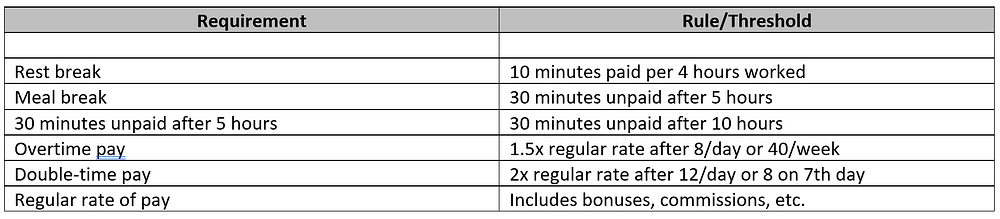
- Non-exempt workers in California are entitled to a paid 10-minute rest period for every four hours (or major fraction thereof) they work.
- These breaks should be scheduled as near as possible to the middle of each work segment.
Meal Periods
- Employees who are not exempt from wage and hour laws must be given a 30-minute unpaid meal break if their shift extends beyond five hours.
- For shifts longer than ten hours, a second 30-minute meal break is required.
- Meal breaks must be provided before the end of the fifth hour, and the second before the end of the tenth hour of work.
Overtime Pay
- California law requires that non-exempt employees receive overtime pay at one and a half times their regular rate for all hours worked over 40 in a week, or over 8 in a single day.
- Double-time pay applies for hours worked beyond 12 in a day or for work exceeding eight hours on the seventh consecutive day.
Key Compliance Issues
- Employers must be diligent in tracking and compensating for:
- The correct “regular rate of pay”
- Any business-related expenses
- Unauthorized or off-the-clock work
- Penalties for missed, late, or incomplete meal and rest breaks
Calculating the Regular Rate of Pay
- The “regular rate of pay” is not always the same as an employee’s hourly wage. It must include all compensation such as:
- Non-discretionary bonuses
- On-call payments
- Shift differentials
- Commissions
- To determine this rate, total all qualifying earnings for the week and divide by the total hours worked in that period.
- This rate is used not only for overtime but also for calculating paid sick leave and premiums for missed breaks.
Consequences of Non-Compliance
Errors in wage calculations or failing to provide required breaks can result in wage claims and significant penalties assessed for each pay period in which a violation occurs.
Employers must remain vigilant in applying these standards to avoid costly mistakes and ensure fair treatment of their workforce.
#2 Distinguishing Exempt and Nonexempt Employees in California
In California, whether an employee is classified as exempt or nonexempt determines their eligibility for overtime pay and other labor protections. Exempt workers are not entitled to overtime or certain wage-and-hour benefits, while nonexempt employees receive these protections under both state and federal law.
Criteria for Exempt Status
To qualify for exempt status, an employee must satisfy two main requirements:
Duties Requirement: The worker’s primary job tasks must fall within specific categories:
- Executive: The individual must primarily oversee the business or a distinct department, manage at least two full-time staff members, and possess authority over major personnel actions.
- Administrative: The main responsibilities must involve office or non-manual work related to business management or general operations, with regular use of independent judgment and discretion on key matters.
- Professional: The role requires specialized knowledge in fields such as science or education, generally obtained through extensive academic training (e.g., attorneys, physicians, certified accountants).
- California law also recognizes exemptions for certain roles, such as computer professionals, creative workers, and outside sales staff, each with its own criteria.
Salary Requirement: The employee must be paid a fixed salary that meets or exceeds the minimum set by state law, regardless of hours worked.
The minimum salary for exempt employees is directly linked to the state minimum wage. For full-time exempt status in 2025, the required annual salary is $68,640 (or $5,720 per month), reflecting twice the state minimum wage for a 40-hour workweek. This threshold automatically rises whenever the minimum wage increases.
Importance of Proper Classification
Incorrectly labeling a worker as exempt when they do not meet both the duties and salary tests can expose employers to serious legal risks. Consequences include liability for unpaid overtime, statutory penalties, and possible damages. Employers must carefully evaluate both the actual job functions and the pay structure to ensure compliance with California’s strict classification standards
Employers should regularly review employee classifications to avoid costly mistakes and ensure they are meeting all legal requirements
#3 Independent Contractor vs. Employee in California
Since January 1, 2020, California’s Assembly Bill 5 (AB 5) has made it significantly more challenging for businesses to classify individuals as independent contractors. The legislation automatically treats workers as employees unless the company can clearly demonstrate that all three criteria of the “ABC test” are satisfied.
The ABC Test: Three-Pronged Requirement
Under AB 5, the previous multi-factor analysis for determining independent contractor status has been replaced by a strict three-part standard. To classify a worker as an independent contractor, an employer must prove:
A) Autonomy: The individual operates free from the company’s control and direction while performing their duties.
B) Outside Business Scope: The tasks performed by the worker are not part of the company’s core business activities.
C) Independent Trade: The worker is independently established in the same type of work, operating their own business or trade.
The “B” element — demonstrating that the worker’s services fall outside the usual business of the hiring company — is often the most difficult to meet. This means businesses can no longer routinely use independent contractors for essential or regular business functions.
Broad Application and Significant Consequences
AB 5 applies to nearly all workers in California, regardless of where the employer is headquartered. Failure to properly classify employees can result in serious repercussions, such as liability for unpaid wages, back taxes, and substantial fines.
Employer Action Steps
- Review Worker Roles: Carefully analyze all existing and new work relationships to ensure proper classification.
- Seek Legal Advice: If there is any ambiguity regarding a worker’s status, consult with legal counsel to avoid costly mistakes.
- Update Policies: Adjust business practices and contracts to comply with the new requirements.
Employers must be proactive in understanding and implementing AB 5’s standards to avoid penalties and ensure compliance with California labor laws
#4 California Broader anti-descrimination Laws
California Fair Employment and Housing Act (FEHA): Overview and Key Differences
The California Fair Employment and Housing Act (FEHA) is the state’s primary law protecting employees from workplace discrimination. Unlike most comparable federal laws, which generally apply only to employers with 15 or more employees, FEHA covers all employers with five or more full- or part-time employees. As a result, a broader range of California employers are subject to state anti-discrimination requirements than to federal law.
Broader Protections Under FEHA
While FEHA incorporates many of the same nondiscrimination principles as federal Title VII laws, California law extends protection to additional categories and often defines protected classes more broadly. In situations where California law is more protective of employees than federal law, the state law takes precedence.
Categories protected under California law — either not covered or defined more broadly than under federal law — include:
- Ancestry
- Religious creed and religious observance
California law specifically protects religious dress and grooming practices, which are not currently covered by federal EEO laws. - Marital status
- Medical condition (including cancer and genetic characteristics)
- Pregnancy
California’s definition includes breastfeeding and related medical conditions, which federal law does not. - Reproductive health decision-making
- Traits historically associated with race
This includes, but is not limited to, hair texture and protective hairstyles.
Types of Discrimination Recognized
California law recognizes the following types of discrimination:
- Disparate treatment
- Disparate impact
- Retaliation
Legal Costs and Litigation Implications Under FEHA
Under the Fair Employment and Housing Act (FEHA), employees who win their cases are entitled to reimbursement for legal expenses, including attorney’s fees, litigation costs, and expert witness charges. This entitlement supersedes the general cost-recovery framework for civil lawsuits in California.
However, the structure of this rule heavily favors employees. Workers who prevail typically receive compensation for their legal fees, except in rare situations where awarding such fees would be considered unjust. In contrast, employers are only able to recoup their legal expenses if the court determines that the employee’s lawsuit was entirely without merit.
Because employees face little financial downside, even when their claims are weak, this arrangement can lead to a higher number of lawsuits being filed. Plaintiffs are incentivized to pursue claims with minimal risk of having to pay the other side’s fees.
Best Practices for Employers
Given the risks associated with FEHA claims, employers are strongly advised to:
- Implement robust anti-discrimination and harassment policies
- Provide regular training to employees and managers
- Promptly investigate and address complaints before they escalate into formal claims
Taking these proactive steps can help minimize legal exposure and foster a fair, inclusive workplace.
#5 Private Attorneys General Act (PAGA)
The California Private Attorneys General Act (PAGA) empowers employees to sue their employers for violations of the California Labor Code, acting on behalf of themselves and other affected employees as well as the state. Since its enactment in 2004, PAGA has become a significant source of legal risk for California employers.
What is PAGA?
Purpose: PAGA deputizes employees to enforce labor laws by filing lawsuits to recover civil penalties that were previously only recoverable by the state.
Representative Action: A PAGA claim is brought on behalf of the employee-plaintiff and other “aggrieved employees,” functioning similarly to a class action but without the formal certification process.
Scope: Applies to private employers for Labor Code violations; government employers are generally exempt.
Why Should Employers Be Concerned?
High Volume of Claims: Thousands of PAGA notices are filed annually, with claims covering wage and hour violations, meal and rest break infractions, misclassification, and increasingly, Cal/OSHA safety violations. Employers should be vigilant About California Private Attorneys General Act (PAGA) Claims
Significant Financial Penalties: Penalties can be substantial, starting at $100 per violation per employee per pay period, potentially escalating to $200 for willful or repeated violations.
No Certification Requirement: Unlike class actions, PAGA claims do not require court certification, making them easier to file and harder to dismiss on procedural grounds.
Reputational and Operational Impact: Beyond financial costs, PAGA lawsuits can harm company reputation and employee morale.
Recent Reforms of PAGA reduces penalties with some caps and also plantiff must personally experience violations.
Employer Best Practices to Mitigate PAGA Risks
Conduct Regular Compliance Audits:
Review payroll, timekeeping, meal/rest break policies, and workplace safety programs to identify and correct potential violations.
Maintain Accurate Records:
Ensure detailed and accurate documentation of hours worked, wages paid, and compliance efforts.
Respond Promptly to PAGA Notices:
Take immediate corrective action within the 60-day cure period to reduce potential penalties.
Train Management and HR:
Educate supervisors and HR personnel on labor law requirements and PAGA risks.
Consult Legal Counsel:
Seek expert advice to navigate PAGA claims, assess risks, and develop strategic responses.
Summary Table: Key PAGA Points for Employers
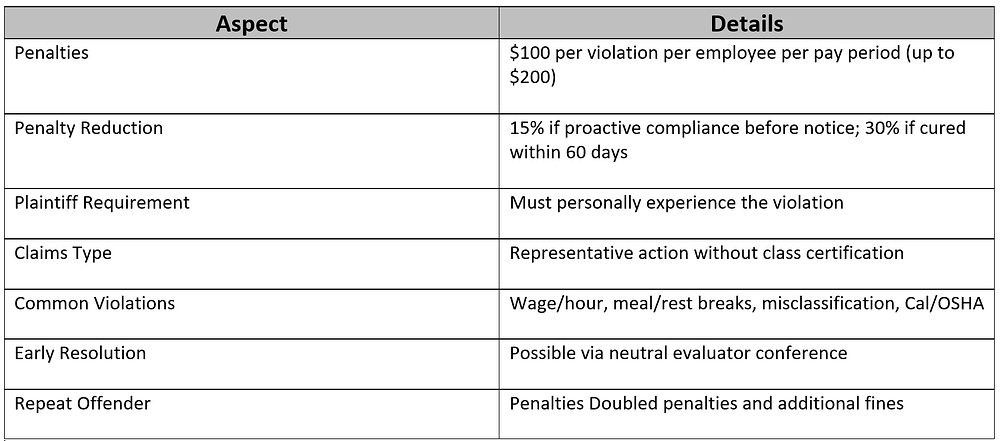
PAGA claims represent a serious and ongoing risk for California employers. While recent reforms provide some relief and incentives for compliance, the potential for significant penalties remains. Employers should be proactive in auditing their practices, maintaining compliance, and responding swiftly to any PAGA notices to minimize exposure.
Taking these steps not only reduces legal risk but also fosters a fair and lawful workplace environment.
#6 Recent California Regulations
California has introduced major updates to labor laws covering indoor heat illness prevention and workplace violence, along with existing sexual harassment. Below are the key compliance steps for each area as of 2025.
Indoor Heat Illness Prevention
Who Must Comply:
All employers with indoor workplaces where temperatures reach 82°F or higher.
Key Requirements:
Written Prevention Plan:
Develop and implement a written Indoor Heat Illness Prevention Plan. This plan must outline procedures for monitoring indoor temperatures, identifying heat hazards, and responding to heat illness incidents.
Temperature Monitoring:
Regularly monitor indoor temperatures and humidity. Take action when indoor temperatures reach 82°F or higher.
Access to Water:
Provide employees with sufficient cool drinking water at all times.
Cool-Down Areas:
Ensure employees have access to cool-down areas or rooms to prevent overheating.
Rest Breaks:
Allow and encourage employees to take cool-down rest breaks as needed.
Training:
Train all employees and supervisors on heat illness risks, prevention strategies, symptoms, and emergency response.
Emergency Procedures:
Establish and communicate procedures for responding to heat illness, including contacting emergency medical services if needed.
Workplace Violence Prevention
Who Must Comply:
Nearly all California employers, with limited exceptions (e.g., certain small, non-public workplaces).
Key Requirements:
Written Workplace Violence Prevention Plan (WVPP):
Create and maintain a written WVPP that addresses:
Identification and evaluation of workplace violence hazards
Procedures for reporting and investigating incidents
Emergency response protocols (alerts, evacuation)
Corrective measures for each work area and operation
Employee Involvement:
Involve employees in identifying hazards, designing training, and reporting incidents.
Training:
Provide initial and annual training to all employees on workplace violence risks, the WVPP, and reporting procedures.
Incident Logs:
Maintain a violent incident log for every workplace violence event and retain records for at least five years.
Annual Review:
Review and update the WVPP at least annually, or after incidents or deficiencies are identified.
No Retaliation:
Prohibit retaliation against employees who report workplace violence.
Sexual Harassment Prevention
Who Must Comply:
All California employers with five or more employees.
Key Requirements:
Written Anti-Harassment Policy:
Maintain a written policy prohibiting sexual harassment, including procedures for reporting and investigating complaints.
Training:
Supervisors: At least two hours of interactive sexual harassment prevention training every two years.
All other employees: At least one hour of training every two years.
Training must cover digital communications, remote work, bystander intervention, complaint procedures, and examples of prohibited conduct.
Prompt Response:
Respond to internal complaints within 14 calendar days.
Recordkeeping:
Preserve all harassment complaint documentation for a minimum of five years, even if the employee leaves.
Lowered Threshold for Claims:
A single severe incident may now constitute harassment; the “severe or pervasive” standard is no longer required.
Supervisor Liability:
Supervisors can be held personally liable for engaging in or failing to address harassment.
No Confidentiality Gag Orders:
Employers may not use confidentiality agreements to silence victims regarding factual information about harassment claims.
Compliance Checklist Table

Tip:
Regularly review and update all policies, conduct required training, and document compliance efforts. Consult legal counsel to ensure all new requirements are met and to address workplace-specific concerns.
Employers who proactively comply with these laws not only reduce legal risks but also promote a safer, healthier, and more respectful workplace.
Conclusion
Successfully navigating California’s HR compliance landscape in 2025 requires small businesses to stay agile, informed, and proactive. With frequent legal updates, overlapping regulations, and some of the nation’s strictest labor standards, employers must prioritize ongoing education, regular policy reviews, and diligent recordkeeping. By investing in robust compliance practices — such as accurate wage calculations, proper employee classification, updated anti-discrimination policies, and thorough training — businesses not only minimize legal and financial risks but also foster a positive and respectful workplace culture. Staying ahead of regulatory changes isn’t just about avoiding penalties; it’s a strategic advantage that protects your company’s reputation and supports long-term success in California’s dynamic business environment.
Hrdeck.com is a platform designed for HR teams and companies to manage policies, compliance and communication effectively. Our solution aids in complying with policies and regulations, thereby safeguarding from any penalties, liabilities and reputation.
Try hrdeck.com now!
References:
[1] https://www.dir.ca.gov/dosh/heatillnessinfo.html
[2] https://www.osha.gov/heat-exposure/standards
[3] https://nam.org/issues/regulatory-and-legal-reform/cost-of-regulations/#crains
[4] https://leginfo.legislature.ca.gov/faces/billTextClient.xhtml?bill_id=202320240SB553