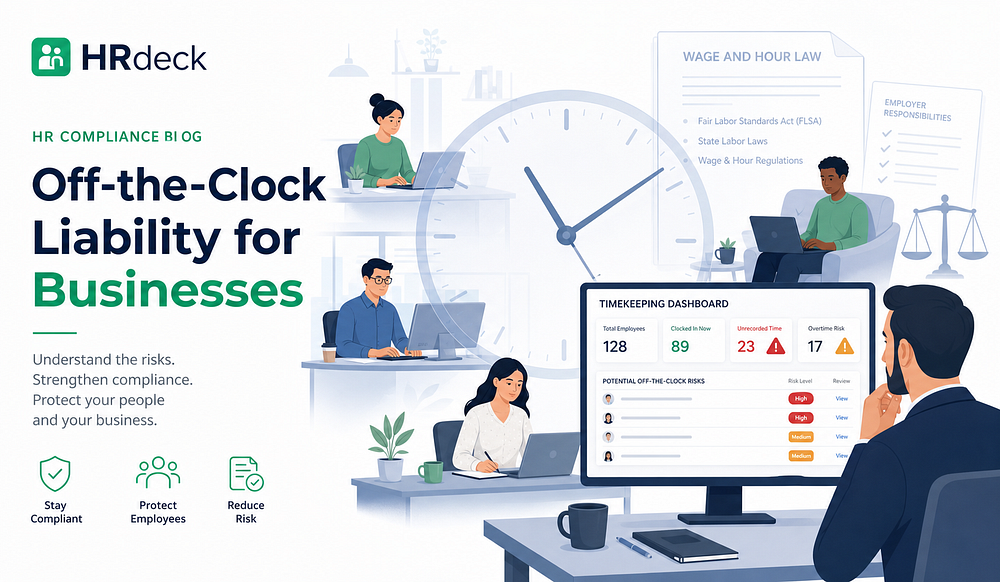
What off-the-clock work means Under the Fair Labor Standards Act (FLSA), covered nonexempt employees must be paid at least minimum wage for all hours worked and overtime at one and one-half times their regular rate for hours over 40 in a workweek. “Hours worked” is broadly defined to include all time an employee must be on duty or at a prescribed workplace, plus any additional time they are allowed, suffered, or permitted to work, even if the work was not requested.[5][6][7] Off-the-clock work occurs when a nonexempt employee performs job-related tasks without recording the time and therefore without being paid. Common examples include answering emails before a shift, finishing tasks after clocking out, handling calls during unpaid meal breaks, or addressing urgent issues at night or on weekends. It can also include pre- and post-shift activities such as walking long distances inside a facility to reach a time clock or going through mandatory security screenings when that time is not captured and paid.[1][2][8][9][4][6][10] Why small minutes become big cases Individually, a few unpaid minutes per day might seem insignificant, and the FLSA does recognize a narrow “de minimis” concept for truly infrequent, tiny increments that cannot be practically recorded. However, regulators emphasize that employers may not arbitrarily ignore regular, identifiable work time just because each chunk is small; if time can be practically tracked and is part of an employee’s normal duties, it must be counted and paid.[9][6][7] When those “quick emails” and “short calls” are repeated across dozens or hundreds of employees, week after week, the unpaid time can translate into substantial back wages and overtime. That is why off-the-clock cases are so often filed as class or collective actions under federal and state wage-and-hour laws, allowing many employees to combine relatively small individual claims into a single, high-impact lawsuit. In addition to unpaid wages, employers may face liquidated (double) damages under the FLSA, attorneys’ fees, and separate statutory penalties under more protective state laws.[1][2][8][3][4] Real-world settlements show the scale of the risk. For example, class actions over unpaid off-the-clock work and missed meal breaks have led to employer settlements in the tens and hundreds of millions of dollars, including a reported settlement exceeding 350 million dollars involving alleged off-the-clock and meal-break violations at a major national retailer. Another recent case involved a large employer agreeing to pay 4.6 million dollars to resolve claims that employees were not paid for time walking to distant time clocks and completing pre- and post-shift security screenings.[4][10] Remote and hybrid work amplify exposure Roughly one in five workers in the United States now work remotely, and projections suggest more than 32 million Americans — about 22 percent of the workforce — could be working remotely by 2025. While flexibility has benefits, it also makes it harder for managers to see when nonexempt employees are actually working, blurring the line between paid and unpaid time and increasing the risk of off-the-clock work.[11][2][8][12] The U.S. Department of Labor has issued updated guidance on tracking compensable hours for remote nonexempt employees, stressing that employers are responsible for paying for all hours they know or have reason to know are being worked. Even if work is done outside scheduled hours or in violation of company policy, employers must still compensate the time if they had actual or constructive knowledge of the work. That includes time spent on tasks that may seem informal or brief: responding to after-hours emails or messages, monitoring collaboration tools, logging in on weekends to “catch up,” or working through meal breaks.[2][5][8][4][11] Remote workforces also tend to be geographically dispersed, sometimes spanning multiple states with different overtime rules, break requirements, and recordkeeping obligations, which can compound compliance risk. Without accurate information about where employees are working and when they are on the clock, multi-state employers can easily slip out of alignment with local wage-and-hour requirements.[8][12][2] Automation Tools As more organizations experiment with generative AI and automation tools, the pattern of off-the-clock work is also shifting. Some employees may use AI tools off hours to draft emails, summarize documents, or prep deliverables, effectively doing unpaid work that benefits the employer. At the same time, properly deployed AI and automation can reduce administrative workload and help employees complete tasks within scheduled hours, which may lower the overall volume of overtime and related claims.[2][8][12] For HR and legal teams, the key is not the technology itself but how it is used and monitored. Timekeeping policies and training should make clear that all work done, including work aided by AI tools, must be recorded, and systems should make it easy to log that time from any device or location. Employers should also be alert to the risk that AI-enabled productivity expectations may indirectly pressure employees to “catch up” off the clock, especially in lean teams or high-demand roles.[13][11][5][8][2] The legal standard for liability Under the FLSA, employers must pay nonexempt employees for all hours they are suffered or permitted to work, regardless of whether the work was authorized. Courts and the Department of Labor distinguish between an employer’s actual knowledge (for example, a manager directly observing or assigning work) and constructive knowledge (what the employer reasonably should have known, given available information and systems).[11][2][5][8][4] Ignorance is not a defense when employers have tools that could reveal off-the-clock work, such as email and messaging logs, system access reports, or time records showing repeated variances around start and end times. Employers can discipline employees for performing unauthorized work outside scheduled hours, but they cannot withhold pay for that time once they know or should know that the work occurred.[2][5][8][4][11] State laws can go further than the FLSA, especially around meal and rest breaks. For example, some states require specific meal and rest periods for nonexempt employees and impose financial penalties when those breaks are missed, shortened, or interrupted. In such jurisdictions, employees who work through required breaks — whether in the office or while working from home — may be entitled not only to wages for the time worked but also to separate premium payments or penalties.[14][15][2]
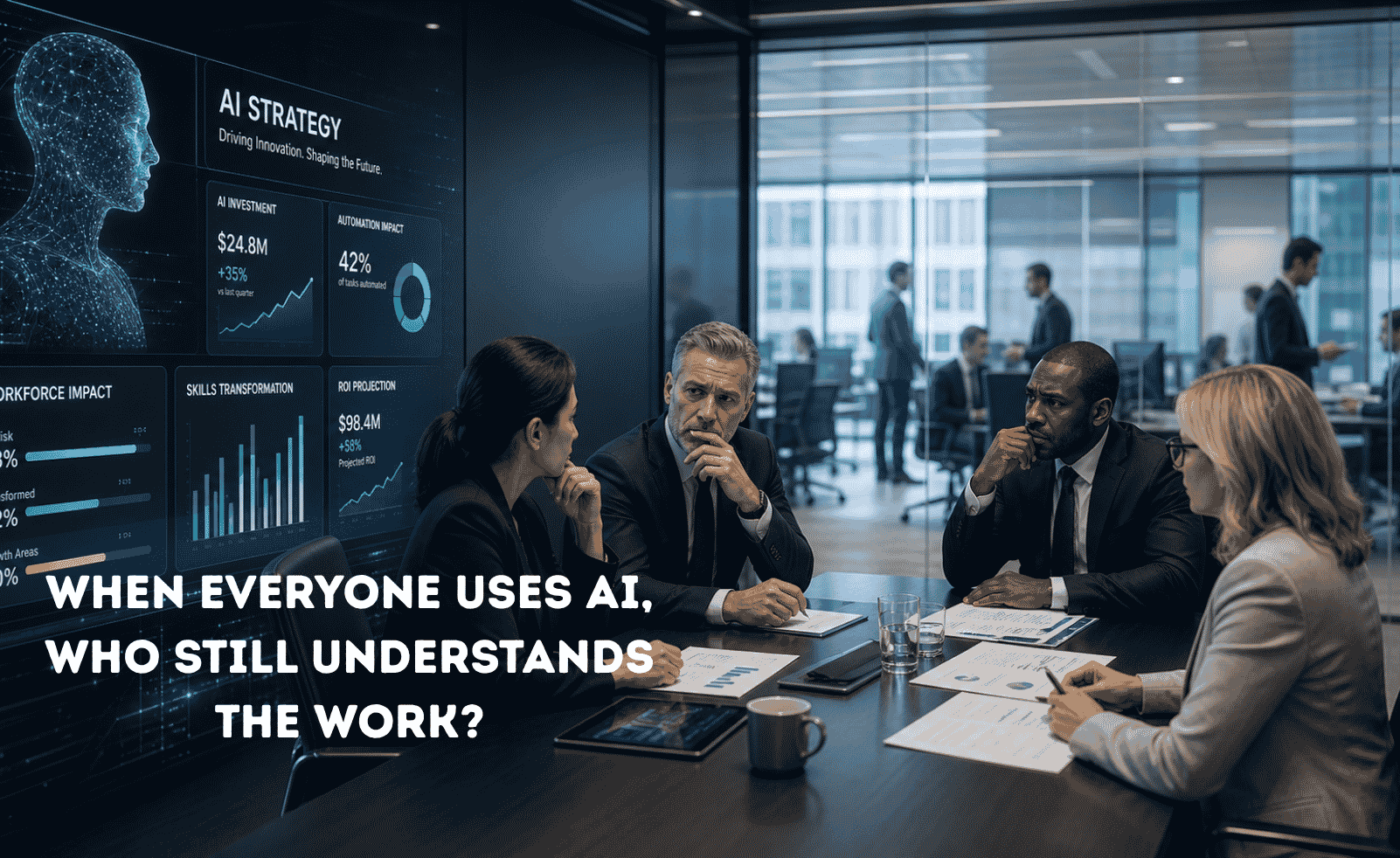
The competency erosion problem: Small Businesses & Nonprofits Recent research suggests that concerns about AI weakening human skills are not abstract. In a 2026 SHRM report on AI in the workplace, workers widely reported both increased use of AI tools and rising unease about how that use affects the quality and originality of their work. Nearly three in five workers surveyed by SHRM said they had worked with a colleague whose actual capabilities did not match the skills they were supposedly hired for, highlighting a mismatch between paper qualifications and observed competence. A similar share — around 57 percent — said they were at least moderately concerned that heavy reliance on AI was leading to lower‑quality work that had not been thoughtfully reviewed or vetted.[1][3] Those worries align with broader research. Strategy analysts at BCG have warned that when organizations lean too hard on AI for knowledge work, they risk eroding critical cognitive skills such as problem solving, judgment, and deep analysis. Academic work has raised similar alarms: a 2024 theoretical paper on AI assistance argued that automated support can accelerate skill decay and hinder skill development, particularly when users stop engaging with the underlying tasks and instead become passive overseers of machine output. A 2023 study on AI and workers’ skills emphasized that without deliberate upskilling and reskilling efforts, AI integration is likely to widen gaps in transversal skills such as critical thinking and adaptability.[2][4][5] What makes this “competency decline” distinct from classic disengagement or burnout is its mechanism. Instead of people doing less work, people may still produce many deliverables — they just do so with less understanding, weaker reasoning, and fewer original contributions. Over time, that hollows out the very capabilities organizations rely on to detect errors, manage risk, and adapt to change.[6][7][8][2] Why small businesses should care first Large enterprises have more redundancy: if one team’s skills atrophy, there are often other teams, formal training programs, and deep specialist benches to catch problems. Small businesses, by contrast, typically rely on a handful of key people handling multiple functions — operations, customer service, basic finance, and HR — often with no dedicated L&D infrastructure. In that environment, AI‑driven competency decline is not a theoretical risk; it can immediately affect customer experience, compliance, and financial performance.[9][10][11][12][2] Small‑business technology surveys show that AI and automation tools are now common even in firms with fewer than 50 employees, where owners frequently deploy them to “do more with less” amid rising costs. SHRM’s State of the Workplace and AI research likewise finds that leaders expect AI integration and AI‑specific upskilling to accelerate, but many organizations have not yet built mature governance structures around these tools. That leaves small employers in a particularly fragile position: they gain efficiency from AI, but lack clear policies, training programs, or metrics to ensure those tools do not quietly weaken human skill over time.[13][2][14][15][3][9] From a risk standpoint, that matters for several reasons: · Error detection and compliance. Small teams often manage payroll, scheduling, and basic legal compliance themselves. If employees stop understanding the logic behind AI‑generated schedules, classifications, or notices, they are less likely to catch mistakes that could trigger wage‑and‑hour violations or other legal exposure.[10][11] · Customer trust. Many small businesses compete on quality and relationships, not scale. If AI‑generated emails, proposals, or recommendations are not truly understood or checked by staff, clients will eventually notice generic or inaccurate work — and may leave.[6][9] · Succession and resilience. When a key employee leaves or is unavailable, a small business needs others to understand critical decisions, not just how to press “generate” again. If AI has masked skill erosion for years, transitions become much riskier.[2][8] In short, small businesses cannot afford to treat AI competency decline as a vague future issue. It is a near‑term operating risk that deserves the same attention as cybersecurity, financial controls, or safety protocols.[12][10] Evidence that skill erosion is already happening Several data points suggest that skill erosion linked to AI is not just hypothetical. SHRM’s 2026 AI research reports indicate that most HR professionals believe repeated drafting, editing, or refining work with AI is at least moderately likely to reduce original thinking. In parallel, workers themselves are noticing the shift: roughly seven in ten workers surveyed said critical thinking is more important now because of AI, implying a sense that the tools make it easier to produce content but harder to distinguish strong answers from weak ones.[1][14] Other surveys have found that a notable portion of workers — 39 percent overall and nearly half of Generation Z in one recent poll — believe heavy reliance on AI has already weakened their own skills. Research teams in Europe have warned that overdependence on AI to guide decisions can hollow out expertise, especially when organizations fail to preserve practice tasks that require human judgment. All of this aligns with broader human‑factors literature suggesting that automation can produce “skill fade” when people no longer engage deeply with procedures they once had to perform manually.[7][4][5][8] Taken together, these findings build a consistent picture: AI can boost productivity, but without safeguards, it also nudges workers into roles where they supervise outputs they do not fully understand. That is competency decline in practice.[6][2] Why policy is the right response (not just training tips) Many employers try to address AI risks informally — telling staff to “double‑check AI outputs” or encouraging people to “still think for themselves.” Those messages help but are insufficient. Competency decline is driven by system design and incentives, not just individual intentions. Without clear policies, workers may feel business pressure to prioritize speed and volume over understanding, especially in small businesses where everyone is stretched thin.[9][16][6][5] Formal AI policies are needed for at least four reasons: 1. Clarifying expectations. When a written policy defines what “responsible AI use” means — where AI can be applied, where it must be avoided, and how human review works — it reduces ambiguity and gives employees concrete guardrails.[1][17] 2. Aligning incentives. If small businesses only measure productivity (e.g., number of tickets closed or documents produced), workers will naturally use AI to maximize volume, even when quality or capability suffers.

As the demand for home care services grows, providers are increasingly exposed to the risk of wage and hour violations, particularly related to overtime. The U.S. Department of Labor (DOL) has tightened enforcement of the Fair Labor Standards Act (FLSA) on home care workers, and the 2013 “Home Care Final Rule” has reshaped the landscape for third-party employers, such as home care agencies. In a recent case, an Ohio-based home care company was found liable for FLSA violations, including willful overtime violations, after the DOL challenged the company’s overtime practices. The 6th Circuit Court of Appeals upheld the DOL’s 2013 regulation, affirming that third-party providers must pay overtime, even for live-in employees or family members providing care. The 2013 rule precluded third-party employers (like home care agencies) from using the companionship services and live-in exemptions, meaning most home care workers must now be paid at least the federal minimum wage and overtime pay. The DOL’s guidance emphasizes that home care workers must be paid for all hours worked, with overtime at one and a half times their regular rate for hours exceeding 40 in a workweek. The 6th Circuit case reinforced that employers cannot avoid overtime liability by reclassifying workers or manipulating hourly rates based on hours worked in a week. The court found that the DOL’s 2013 regulation was valid and enforceable, and that the 1974 amendments to the FLSA expressly delegated authority to the DOL to define and regulate these exemptions. For home care agencies, avoiding risk means understanding the companionship services and live-in exemptions, ensuring accurate timekeeping, and maintaining proper records. The FLSA’s companionship services exemption is narrow, applying only when workers spend no more than 20% of their time on personal care tasks and do not perform medically related duties. The live-in exemption applies only to employees who reside in the household and are not paid by a third-party employer. The DOL’s enforcement actions highlight that agencies cannot bypass these rules, and courts have consistently upheld the 2013 regulation despite challenges to the DOL’s authority. In 2025, the DOL suspended enforcement of the 2013 rule temporarily, but proposed a rule to restore the pre-2013 framework, which could allow third-party employers to reclaim the exemptions. However, until final rules are issued, agencies must remain compliant with current requirements to avoid costly back-pay claims and penalties. The 6th Circuit case serves as a warning that employers cannot ignore or reinterpret the 2013 regulation; they must pay overtime where required. HR and agency leaders should prioritize clear policies, regular audits, and training to mitigate risk. By staying informed on evolving regulations and ensuring workers are paid correctly, home care providers can avoid the legal and financial pitfalls of overtime violations.[1][2][3] Legal Compliance: The 2013 FLSA Rule and Its Impact The 2013 FLSA rule fundamentally changed how home care workers are compensated. The DOL’s Home Care Final Rule expanded wage protections, requiring most home care workers to receive at least the federal minimum wage and overtime pay. The rule precluded third-party employers from using the companionship services and live-in exemptions, meaning agencies must now pay overtime for hours worked over 40 in a week. The 6th Circuit’s decision in the Ohio case reaffirmed that this rule is valid and enforceable, and that employers cannot avoid overtime liability by reclassifying workers or manipulating pay structures. The court found that the 1974 amendments to the FLSA expressly delegated authority to the DOL to define and regulate these exemptions, and that the 2013 regulation was a reasonable interpretation of the statute. As a result, agencies must comply with current requirements, even as the DOL proposes to restore the pre-2013 framework.[2][3] Identifying Exemptions and Non-Exempt Employees Home care agencies must understand the narrow scope of the companionship services exemption and the live-in exemption. The companionship services exemption applies only when workers spend no more than 20% of their time on personal care tasks and do not perform medically related duties. The live-in exemption applies only to employees who reside in the household and are not paid by a third-party employer. The 2013 rule eliminated the ability of third-party employers to claim these exemptions, meaning most agency-hired home care workers are non-exempt and entitled to overtime pay. The 6th Circuit case emphasized that employers cannot bypass these rules, and that courts will uphold the DOL’s interpretation.[1][2] Timekeeping, Recordkeeping, and Overtime Calculations Accurate timekeeping and recordkeeping are essential for compliance. The FLSA requires employers to keep records of hours worked each day and total hours each week, wages paid, and any deductions or credits. The DOL’s guidance recommends that employers maintain a consistent workweek and track all hours worked, including travel time and on-call time. The 2013 rule also clarified that live-in workers must be paid for all hours worked, with sleep time and other breaks excluded only under specific conditions. The 6th Circuit case reinforced the importance of maintaining accurate records, as the DOL’s enforcement action was based on the employer’s failure to track and pay for all hours worked.[2][1] Mitigating Risk Through Policy and Training Home care agencies can mitigate risk by implementing clear policies, training managers, and conducting regular audits. The DOL’s guidance recommends that employers review their pay practices, update employee handbooks, and ensure that workers understand their rights. The 6th Circuit case highlights the importance of consistent enforcement and the need to train managers on the 2013 rule. Agencies should also consider using technology to track hours and automate compliance checks. By staying informed on evolving regulations and ensuring workers are paid correctly, home care providers can avoid the legal and financial pitfalls of overtime violations. The DOL’s proposed rule to restore the pre-2013 framework may offer some relief, but until final rules are issued, agencies must remain compliant with current requirements.[3][2] The Role of Technology and Best Practices Technology can play a key role in mitigating overtime risk. Home care agencies should consider using scheduling software to prevent over-scheduling, automate overtime alerts, and track hours accurately. The DOL’s guidance
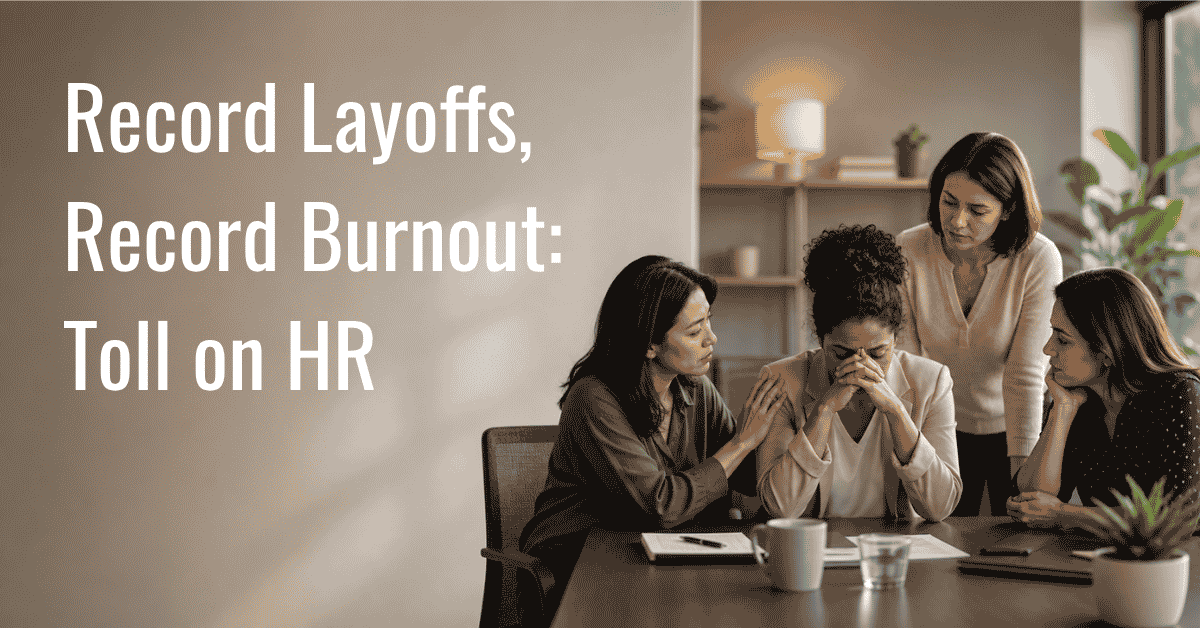
In recent years, HR teams have been on the front lines of repeated layoff cycles, restructuring, and constant uncertainty. U.S. employers announced more than 1.2 million job cuts in 2025, a 58% increase over 2024 and the highest annual total since the early pandemic years. Tech alone shed roughly 244,851 roles globally in 2025, with U.S. companies accounting for nearly 70% of those cuts. Early 2026 data suggests the trend is still far from over, with tens of thousands of additional job reductions already announced across industries.[1][2][3][4][5][6][7] For the people teams behind these numbers, the emotional and operational load is immense. HR professionals orchestrate communications, coach managers through tough conversations, sit with their colleagues’ shock and grief, and then turn around to support the “survivors” who remain. They are expected to be steady, compassionate, and compliant all at once — often while worrying about their own job security.[8] Yet the toll on HR is frequently overlooked. New research shows that burnout is worsening across the workforce: 44% of U.S. employees report feeling burned out at work, while 51% say they feel “used up” at the end of the workday. HR professionals are often hit even harder; one 2024–2025 analysis found that 84% of HR leaders report frequent stress, 81% feel burned out, and 95% say the job is “too much work and stress” at least some of the time. In a year of record layoffs, that strain only intensifies.[9][10][8] This moment demands something different from employers. Caring for HR teams is not a soft, optional perk — it’s a risk-management and culture-preservation strategy. The weight of “record” layoffs Layoff announcements are not just headlines; they represent a prolonged period of anxiety and emotional labor for HR. In the United States, job cut announcements surpassed 1 million in 2025, up more than 50% from the previous year and marking the highest level since the 2020 pandemic crash. The outplacement firm Challenger, Gray & Christmas reported 1,206,374 job cuts for the full year, the seventh-highest annual total since they began tracking in 1989.[2][8][4] Technology has been at the center of this wave. Data compiled by RationalFX shows 244,851 tech layoffs worldwide in 2025, with approximately 170,630 of those cuts in U.S.-headquartered companies alone. Early 2026 reports suggest more than 30,000–45,000 additional tech jobs have been eliminated in just the first few months, and analysts expect total tech layoffs in 2026 to potentially surpass 2025 levels.[1][3][5][7] These cuts are driven by a mix of macroeconomic pressure, higher interest rates, and aggressive adoption of automation and AI, which is now explicitly cited as a reason for tens of thousands of job cuts. For HR, that means more restructuring, more complex workforce planning, and more emotionally charged conversations — often without additional resources.[11][12] The hidden cost on HR teams Burnout is now one of the defining risks of modern work, and HR is not exempt. SHRM’s 2024 Employee Mental Health research found that 44% of workers feel burned out, and 45% feel emotionally drained by their work. Employees experiencing burnout are nearly three times more likely to be actively job hunting and significantly less likely to go above and beyond their basic responsibilities.[9] For HR pros, the risk is amplified by the nature of their work. Experts describe HR burnout as a response to chronic exposure to “emotional labor overload,” where professionals are constantly mediating conflict, delivering hard news, and holding the emotional weight of organizational change. Studies and practitioner surveys show that HR professionals report higher rates of stress and burnout than many other roles, driven by understaffing, expanding responsibilities, and the pressure to be “always on.”[8][10] Other workplace research underscores how this environment erodes well-being. HR.com’s 2025 Future of Employee Well-being report highlights stress and burnout (57%) and understaffing (41%) as the top threats to employee well-being in many organizations. Mid-level managers — often including HR business partners — report some of the highest levels of burnout, with over half saying they feel burned out in the past year.[13][14] When HR carries repeated layoff cycles on top of this baseline stress, the effect is cumulative: compassion fatigue, emotional exhaustion, decision fatigue, and a growing sense of detachment. Without structural support, the very teams tasked with protecting culture and compliance risk sliding into quiet disengagement themselves.[8] Why HR pain is often invisible HR professionals are expected to be both the shock absorber and the role model. They are the ones drafting scripts for managers, coordinating severance logistics, responding to legal questions, and fielding raw, emotional reactions from impacted employees. After a reduction in force, they pivot immediately to re-onboarding “survivors,” fielding complaints about workload, and reassuring leadership that the organization will stabilize.[8] There are several reasons their pain is easy to miss: Role expectations. HR is supposed to be composed, confidential, and neutral, which discourages open discussion of their own distress.[8] Structural isolation. Many HR teams are small and overextended, especially in mid-sized organizations and nonprofits.[15] Stigma around mental health. Even as organizations promote mental health resources, employees (including HR) often feel uncomfortable discussing their mental health at work, citing stigma, fear of retaliation, or lack of support.[13] The result is a group of professionals who may be burning out in silence, even as they are tasked with designing well-being programs for everyone else. What employers can do: institutional support The single most powerful lever for protecting HR in a layoff-heavy environment is institutional support — policies, resources, and norms that make emotional well-being part of how the organization operates, not just something individuals manage alone.[14] 1. Design workloads and staffing for reality Layoffs typically shrink headcount across the company, but HR’s workload usually spikes. Employers should:[8] Budget for temporary or project-based HR support during major restructuring, such as interim recruiters, ER consultants, or outplacement partners. Prioritize and sequence projects so HR is not simultaneously handling layoffs, policy overhauls, and major transformation initiatives. Clarify what can be paused; not every “nice-to-have” initiative should survive a major reduction in force. Research on burnout consistently points to chronic overload and understaffing as key drivers of mental health risks. Adjusting
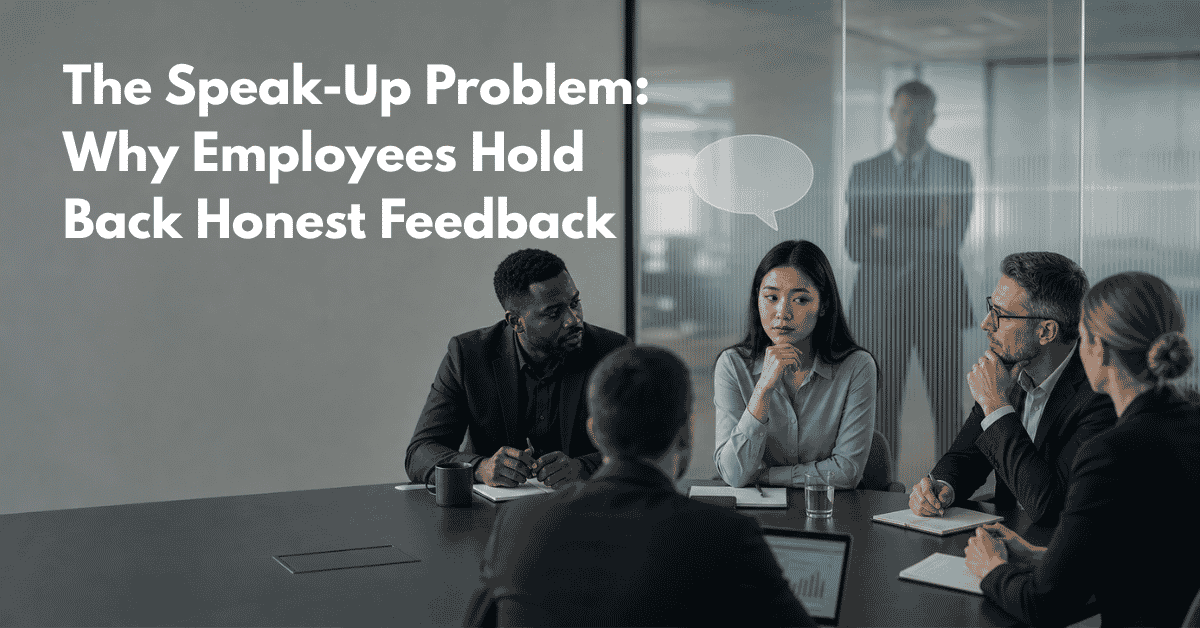
A recent survey from executive coaching firm Radical Candor found that 6 in 10 employees are afraid to speak up about concerns at work, highlighting a widening “trust gap” between leadership and staff. In the same research, 46% of executives said a lack of honest feedback across the company was their top concern, while 67% of HR leaders reported seeing employees stay silent about issues.[2][3][1] This trust gap is not just about feelings; it shows up in the mechanics of feedback. Only 42% of U.S. employees say they have a formal opportunity to provide feedback to their manager, and just 24% report ever formally rating their manager’s performance. At the same time, 96% of employees believe regular feedback helps them improve, and 65% say they want more feedback than they currently receive — evidence that the appetite for open dialogue is there, but the systems and safety to support it are not.[5][6] What “lack of honest feedback” looks like day to day When employees do not feel safe to speak up, you see a pattern of silence, vague comments, and “sanitized” feedback that never touches real business problems. In Radical Candor’s research, more than 60% of respondents said they had seen colleagues stay quiet even when they disagreed or noticed issues, often because they feared retaliation or believed nothing would change.[3][7][1] Even when feedback conversations do happen, they are often shallow or one‑sided. Only 16% of employees say their most recent feedback conversation felt “deeply meaningful,” and just 26% strongly believe the feedback they receive actually helps them do their jobs better. Feedback tends to flow downward from manager to employee, with only 36% of managers receiving any formal peer feedback and the majority of employees never asked how they prefer to be recognized or coached.[6][5] Why employees stay silent Fear of consequences and low psychological safety Gallup’s research on psychological safety shows that many employees stay quiet because the perceived risk of speaking up feels higher than the benefit. Only about three in ten U.S. workers strongly agree that their opinions count at work — but Gallup estimates that raising that to six in ten could reduce turnover by 27%, cut safety incidents by 40%, and increase productivity by 12%.[7] Employees who have seen colleagues punished, sidelined, or simply ignored after raising concerns quickly learn that silence is safer. In environments where layoffs and restructuring are common, people are even less likely to deliver uncomfortable truths — Kim Scott notes that in a climate of downsizing, many workers worry that being candid will put a target on their backs.[1][7] Eroding trust in institutions and leaders The broader trust climate is not helping. The 2026 Edelman Trust Barometer reports that seven in ten people globally are unwilling or hesitant to trust someone who holds different values or information sources, and nearly seven in ten respondents fear that institutional leaders are deliberately misleading the public. In this context, employees often extend their skepticism to corporate leaders, assuming that their concerns will be spun, minimized, or weaponized.[8] Other data point to a simmering sense of grievance. Commentary on Gallup and Edelman’s 2025 reports notes that six in ten people across 28 countries say they feel moderately or highly aggrieved, believing that business and government mainly serve narrow interests while ordinary workers struggle. When employees start from a belief that leadership is “not on their side,” they are far less likely to volunteer honest feedback.[9] Anxiety about AI and job security Radical Candor’s report also connects feedback reluctance to the rapid introduction of AI into work. The study found that inaccuracies appear in AI-assisted work about 73% of the time, yet more than half of workers and managers say quality concerns about AI outputs are “only sometimes or rarely acted on.” Employees worry that raising concerns about AI tools or pointing out flaws could be interpreted as resistance to change, or worse, could accelerate automation that threatens their own jobs.[3][1] In organizations where leaders talk about AI primarily as a cost-savings lever, employees are understandably cautious about offering frank feedback on how those tools are affecting quality, workload, or fairness.[1][3] The business cost of silence Disengagement and lost productivity The silence around honest feedback feeds directly into disengagement. Gallup reports that U.S. employee engagement fell to a 10‑year low in 2024, with only 31% of employees engaged and 17% actively disengaged — numbers that match the worst levels seen in the past decade.[4] HRdeck’s analysis of disengagement estimates that this disengagement now costs the U.S. economy around 2 trillion dollars in lost productivity annually, with disengaged employees being 18% less productive, 37% more absent, and associated with 23% lower profitability than their engaged peers. Workers who feel unheard and unable to give honest feedback are much more likely to drift into quiet quitting or outright withdrawal.[10][4] Turnover and talent risk Poor feedback environments also drive attrition. A recent study highlighted in Borderless AI’s 2026 summary found that people receiving low‑quality performance feedback were 63% more likely to leave than others, and 17% of respondents named insufficient feedback as a primary reason they were looking for new roles.[6] Pew Research similarly notes declines in employees who are “extremely or very satisfied” with the amount of feedback they receive, linking this to broader drops in satisfaction with pay, benefits, and manager relationships. When employees are dissatisfied on multiple fronts and feel they cannot safely say so, many simply exit rather than fight for change internally.[11] Compliance, culture, and reputational risk Silence about concerns is not just a cultural issue — it can become a compliance and legal problem. Research on workplace misconduct and “speak up” culture describes a persistent “trust gap” where employees hesitate to report issues because they fear not being taken seriously or worry about retaliation. Many HR and compliance leaders are surprised that official complaint data significantly under-represents the actual level of misconduct employees report experiencing or witnessing.[12] In states like California, where laws around harassment, workplace violence, and retaliation are tightening, failing to create safe feedback channels can expose employers to serious
Gen Z is rewriting the rules of work. If employers want to attract and keep them, policies, culture, and communication all need an upgrade. Why Gen Z priorities matter now Gen Z (roughly those born between 1997 and 2012) is rapidly becoming a core part of the labor market, with estimates that they will account for more than a third of the global workforce within the next few years. They are also the most diverse, best‑educated, and most digitally native generation to hit the workplace, which means their expectations are materially different from previous cohorts.[1][2][3] At the same time, overall employee disengagement remains a major business risk: only about 31% of U.S. employees are actively engaged at work, while 17% are actively disengaged, costing the economy an estimated 2 trillion dollars in lost productivity. When you combine a disengaged workforce with a rising generation that has few ties and is willing to walk away from misaligned employers, the stakes for understanding Gen Z priorities are high.[4] Who Gen Z are at work Gen Z is the first generation to grow up fully online: smartphones, social media, on‑demand content, and algorithm‑driven news have shaped not only how they communicate, but what they expect from employers. They are also the most ethnically diverse cohort to date; Pew and other researchers note that they place a high value on racial and ethnic diversity in society and inside organizations.[5][6][2][1] Values-wise, surveys consistently show that Gen Z is focused on flexibility, well‑being, and meaning as much as — and sometimes more than — traditional markers like title or office status. They care about whether work aligns with their ethics, whether leaders are walking the talk on inclusion and sustainability, and whether the job allows room for side projects, learning, and a life outside of work.[7][8][9] Priority 1: Flexibility as a non‑negotiable For many Gen Z workers, flexibility is not a perk; it is the baseline expectation. Research shows: Workplace flexibility ranks as the top priority for roughly 75% of Gen Z employees, outranking salary in some studies.[10] Around 41% of Gen Z workers say remote work options are a key job perk, and 65% prefer roles with flexible hours instead of strict 9‑to‑5 schedules.[9] A large majority prefer hybrid arrangements: one study found 71% of Gen Z want hybrid work, while only 23% want fully remote and 6% want fully in‑person roles.[11] In another survey, 62% say they prefer a hybrid pattern of two or three days in the office and the rest remote.[9] This expectation goes beyond location. As hybrid work has spread, many Gen Z employees now favor “micro‑shifting” — working in shorter, non‑linear blocks aligned with their energy and life responsibilities, instead of a fixed, continuous block of hours.[5] That flexibility is reinforced by the fact that many younger workers have fewer fixed commitments like homeownership or children, giving them more freedom to leave and search for roles that better match their desired lifestyle. Coupled with rising side‑hustle culture, Gen Z can often afford to be selective.[12][13] What employers should do Move from ad‑hoc flexibility to clear frameworks. Hybrid and remote work should be governed by written policies, not one‑off manager decisions, to avoid inconsistent treatment and compliance risk.[14][15][16] Update handbooks and procedures. Many organizations added remote work during the pandemic but never updated timekeeping, overtime, digital conduct, and reimbursement rules, creating policy gaps that frustrate younger workers and expose the business.[15][16] Design flexibility with accountability. Clearly define collaboration norms (core hours, meeting expectations, response time standards) so flexible arrangements are sustainable for both the business and Gen Z employees who value autonomy.[17][5] Priority 2: Purpose, sustainability, and social impact Gen Z does not just “like” mission-driven work; they actively screen for it when evaluating employers. Several data points stand out: In Deloitte’s global survey, about 70% of Gen Z and millennials say a company’s environmental credentials are important when considering an employer, and roughly 15% report changing jobs over sustainability concerns.[7] Around 40% of respondents in that same research said they have left employers or rejected opportunities because a company’s environmental or ethical values did not align with their own.[7] A YourCause report found that 75% of Gen Z consider a company’s social impact when evaluating prospective employers, more than 60% believe businesses have a responsibility to promote social equality, and nearly 45% have turned down employers they felt were not doing enough.[8] Another analysis notes that 72% of Gen Z workers want their jobs to make a positive social impact.[9] Crucially, this generation has a low tolerance for empty messaging. They are skilled at researching brands online and expect concrete proof of corporate social responsibility (CSR), including measurable outcomes and transparent reporting — not just slogans.[18][8] What employers should do Make purpose visible in policy, not just marketing. Employee handbooks and onboarding materials should clearly articulate mission, values, and how those values show up in day‑to‑day practices, not just in a brand deck.[19][20] Connect CSR and work. Tie sustainability and community initiatives to employees’ actual roles — through volunteer days, impact goals, or product roadmaps — so Gen Z can see how their work advances the mission.[21][8] Measure and report. Publish annual or semi‑annual updates on environmental and social metrics. Gen Z is looking for data and progress, not one‑time campaigns.[8][7] Priority 3: Diversity, equity, and inclusion as table stakes Diversity, equity, and inclusion (DEI) are not “nice to have” benefits for Gen Z; they are a critical decision factor in whether to accept — or stay in — a job. Surveys paint a consistent picture: In a Tallo survey of more than 1,400 Gen Z respondents, 99% said that workplace DEI is important, and 87% called it “very important.”[22] Yet only 38% of Gen Zers believe American workplaces are truly diverse, equitable, and inclusive, with confidence dropping further for LGBTQ+, Black, and Latino respondents.[22] A Monster survey found that 83% of Gen Z candidates consider a company’s commitment to diversity and inclusion important when choosing an employer.[3] A ManpowerGroup report cited by the World Economic Forum shows 56% of Gen Z would not accept
Many employers think of the employee handbook as a one-time document they update only when they remember or when a major problem appears. In reality, an outdated handbook can create legal exposure, inconsistent management practices, employee distrust, and operational confusion that quietly hurts the business long before a formal claim is filed.[6][1][4] That risk is growing because the workplace has changed quickly in the last few years. Hybrid work remains common, state leave laws continue to expand, AI use is rising across workplaces, and employers still need to be careful that handbook rules do not interfere with protected employee rights under labor law. When a handbook fails to reflect those realities, it stops being a protective tool and starts becoming evidence that the business is behind.[2][5][7][8][1][3][4] Why employee handbooks still matter At their best, employee handbooks do much more than summarize workplace rules. They set expectations, explain policies, support consistency, and communicate how the organization wants employees and managers to operate day to day.[9][1] They also matter in moments of conflict. When an employee raises a concern about leave, discipline, harassment, attendance, confidentiality, or workplace conduct, the handbook often becomes one of the first documents everyone looks at. If the language is outdated, vague, or inconsistent with actual practice, it can weaken the employer’s position immediately.[4][6][9] An employee handbook is also one of the clearest written signals employees receive about organizational culture. The tone, accessibility, and relevance of the document can either reinforce trust or suggest that leadership is disconnected from how people actually work.[10][1] How employee handbooks can hurt your business An employee handbook can absolutely hurt your business, but usually not because you have one. It hurts the business when it is outdated, overbroad, unclear, ignored, or inconsistent with reality. The fix is not to abandon the handbook. The fix is to maintain it like the operational and legal tool it was always meant to be.[1][15][6] 1. Outdated policies can create legal exposure One of the most obvious risks is legal noncompliance. Employee handbooks that contain old leave rules, outdated wage-and-hour language, obsolete complaint procedures, or overly broad work rules can expose employers to claims and agency scrutiny.[5][3][4] This is especially important in areas where the law changes frequently. In 2025, employers had to track new or updated paid sick leave developments in multiple states, including Alaska, Missouri, Nebraska, and Connecticut, among others, which shows how quickly handbook language can become stale if it is not reviewed regularly. If your handbook has not been reviewed in the last year or two, there is a real chance that at least one policy no longer matches current legal requirements.[11][12][1][3] The same issue applies to labor-law-sensitive policies. Employers still need to be careful with rules on confidentiality, civility, workplace recordings, social media, and employee communications because broad handbook language can be challenged if employees could reasonably interpret it as limiting protected concerted activity.[8][13][5] 2. A stale handbook leads to inconsistent management A handbook can also hurt the business when managers treat it as optional or when the written rules do not match day-to-day practice. If the handbook describes formal progressive discipline but supervisors handle discipline differently across teams, employees may view the process as unfair or retaliatory.[6][9] Inconsistent application is often where handbook problems become employee relations problems. A policy may look harmless on paper, but if one manager applies it strictly while another ignores it, the company can end up with morale issues, credibility problems, and more internal complaints.[14][9][6] This kind of mismatch is especially risky for small and midsize employers because managers often rely heavily on the handbook when making people decisions. If the handbook is unclear or outdated, they are more likely to improvise, and improvisation is rarely where compliance gets stronger.[9][4] 3. It can confuse employees instead of guiding them A handbook should answer questions, not create more of them. When policies are written in dense legal language, fail to define expectations clearly, or do not reflect how work actually happens, employees are left guessing about what rules apply and where to go for help.[1][9] That confusion creates friction in onboarding, performance management, leave requests, and everyday workplace communication. Employees may rely on outdated handbook provisions, and managers may spend extra time trying to explain practices that the handbook should have clarified in the first place.[14][9] Over time, that confusion becomes expensive. Even if it never results in litigation, it drains management time, increases HR cleanup work, and makes the company look less organized than it should.[9][14] 4. It can undermine culture and employee trust A handbook is not just a legal document. It is also a culture document, whether leadership intends it to be or not.[10][1] If the handbook reads like a penalty manual full of warnings and disclaimers, employees may take away the message that leadership is focused more on control than fairness. If it says nothing meaningful about respect, inclusion, reporting concerns, or employee well-being, it can make the organization feel out of step with modern workplace expectations.[1][10] This matters because employees often judge a company’s seriousness by the clarity and tone of its internal policies. A handbook that feels neglected can signal that other people processes may also be neglected.[4][1] 5. It may ignore remote and hybrid work realities One of the biggest gaps in many handbooks is that they still reflect a workplace model that no longer exists. Hybrid work remains deeply embedded in the U.S. labor market, with WFH Research reporting that about 27 percent of paid workdays in the United States were work-from-home days in mid-2025, while Gallup reported that hybrid remained the dominant arrangement among remote-capable employees in 2025.[7][15][16] Yet many handbooks still say little about remote schedules, digital communication norms, home-office expectations, expense reimbursement, availability windows, cybersecurity practices, or video-meeting etiquette. When the handbook ignores these practical issues, managers create their own rules and employees get mixed signals about what is expected.[15][1] That creates both legal and operational risk. A handbook that assumes everyone is on-site can leave major
As Generation Z reshapes the future of work, employers need to move beyond buzzwords and headlines and adopt a more evidence-based approach to understanding what this generation actually wants from work. The old caricatures of Gen Z as lazy, entitled, distracted, or disloyal are not just inaccurate; they can actively damage recruiting, manager credibility, retention, and internal mobility.[4][5][6][2] The core misunderstanding is treating Gen Z actions as character flaws rather than logical responses to a new world of work. They entered the workforce after formative years shaped by economic turmoil, pandemic disruption, widespread digitization, and a labor market that often seemed to offer less stability than earlier generations were promised. SHRM summarizes this context well, noting that Gen Z grew up with a well-being mindset, spent most of their lives online, and is especially anxious about the rise of AI at work.[2][3] That context matters enormously. When a younger employee questions a process, asks for more feedback, values flexibility, or wants to understand why their work matters, many employers still interpret that as defiance or fragility. In reality, much of that behavior reflects a generation shaped by optimization, instant access to information, and skepticism toward outdated systems that waste time or feel disconnected from real outcomes.[7][4][1][2] The data increasingly shows that employers have a perception problem as much as a Gen Z problem. Forage reports that nearly a third of hiring managers say they avoid hiring Gen Z in favor of older generations, and 74% of managers and business leaders say they find Gen Z more challenging to work with than other generations. Predictive Index adds that more than half of Gen Z employees report receiving feedback from managers that feels inaccurate or misaligned with how they see themselves, and 62% say they have been overlooked for career opportunities due to misperceptions.[4][1] That gap between employer assumptions and employee reality is where retention problems begin. If a manager assumes a Gen Z employee lacks commitment, that manager is less likely to invest in coaching, stretch work, or trust-building, and the employee is more likely to disengage or leave. Misunderstanding becomes a self-fulfilling cycle: employers stereotype Gen Z as hard to manage, then manage them poorly, then use the resulting friction as proof the stereotype was true.[1][4] Why employers misunderstand Gen Z A useful starting point is SHRM’s framing that generational behavior should be understood as “trends, not traits.” That distinction matters because it shifts the conversation away from moral judgments and toward formative conditions: what people grew up with, what they were taught to expect, and what they have learned about risk, technology, work, and identity. Employers who ignore that context often default to hearsay, anecdote, and intergenerational comparison instead of evidence.[2][4] One major source of misunderstanding is that Gen Z’s preferences often collide with older managerial norms. Deloitte’s 2025 Gen Z and Millennial Survey found that Gen Z is highly focused on growth and learning, but only 6% say their primary career goal is to reach a leadership position. To some employers, that can sound like a lack of ambition, but Deloitte says the better interpretation is that Gen Z is balancing money, meaning, and well-being rather than organizing life around a single ladder-climbing definition of success.[3][2] Another source of confusion is the way Gen Z communicates expectations. This generation is more likely to say directly that a process is inefficient, that they want faster feedback, or that they are not willing to sacrifice health and life boundaries for unclear rewards. Older leaders can hear that as entitlement, yet SHRM’s reporting suggests those expectations are tied to a well-being mindset and to a broader reassessment of what work should demand from people.[7][1][2] Technology is another double-edged factor. Employers often assume Gen Z is automatically technologically fluent because they grew up online, but Cloudbooking notes that digital-native assumptions are often overstated and that many Gen Z workers are more comfortable with consumer technology than workplace software. That means employers sometimes make two mistakes at once: they stereotype Gen Z as screen-addicted while also underinvesting in structured workplace training because they assume younger workers will simply “figure it out.”[8][9][4][2] A third misunderstanding comes from confusing caution with weakness. SHRM reports that Gen Z has significant AI anxiety, and cites research showing that 35% of U.S. workers say they are concerned AI will displace their job in the next five years, while 77% of HR managers say they have not been tasked with assessing AI’s impact on work. For a generation entering the workforce as automation, generative AI, and rapid platform shifts reshape jobs, asking hard questions about future relevance is not irrational; it is prudent.[3][2] Financial context also matters. Deloitte found that 48% of Gen Z respondents in its 2025 global survey did not feel financially secure. When employers interpret salary questions, side-hustle thinking, or strong interest in benefits as greed, they may be ignoring the fact that many younger workers are making career decisions under real financial strain rather than abstract idealism.[6][3] The last major driver of misunderstanding is simple narrative inertia. Every incoming generation is labeled soft, impatient, self-absorbed, or unrealistic at first, and Gen Z is now receiving the same treatment that millennials received years ago. Employers who rely on cultural shorthand instead of data are not really responding to Gen Z; they are reacting to a recycled management story.[5][9][4] The stereotypes that keep showing up — and what the data says instead One of the most common stereotypes is that Gen Z lacks work ethic. Forage lists “Gen Z doesn’t want to work” as one of the most common myths, while GWI says headlines around “quiet quitting” have painted Gen Z with a broad brush that makes them appear lazy when the data shows a more pragmatic relationship to work. In many cases, what employers call weak work ethic is actually a stronger expectation that effort should connect to outcomes, growth, and human sustainability.[6][4][2][3] A related stereotype is that Gen Z only cares about money. Deloitte’s 2025 survey tells a
You finally found the perfect candidate. Their resume is impressive, they nailed every interview question, and their LinkedIn profile checks every box. You extend the offer, onboard them with excitement, and then — within weeks — reality sets in. The work isn’t getting done. The skills aren’t there. And now you’re managing a problem that should never have walked through your door. This is skillfishing, and if you run a small business or manage HR for a lean team, it may already be costing you more than you realize. What Is Skillfishing? Skillfishing is a term coined and popularized by SHRM to describe candidates who misrepresent or exaggerate their skills, experience, and expertise during the hiring process — then underperform once on the job. Think of it as the hiring equivalent of catfishing: the person who showed up to work is not the person you thought you were getting.[1][2][3] This isn’t simply about candidates putting their best foot forward. Most people polish their resumes, and that’s expected. Skillfishing crosses a line when the gap between presentation and reality is large enough to impact job performance, disrupt your team, and drain your bottom line.[1] According to a GCheck survey cited by SHRM, 93% of recent job seekers admitted to embellishing or misrepresenting themselves during the application process. That’s not a minor data point. That’s nearly every candidate in your applicant pool.[1] Why Skillfishing Is Getting Worse in 2026 The problem isn’t new, but several modern trends have made it significantly easier for candidates to inflate their qualifications: AI-generated resumes can transform average experience into polished, keyword-rich credentials that impress automated screening tools and human reviewers alike.[2][3] Interview coaching helps candidates deliver confident, well-rehearsed answers that sound authoritative — even when real-world ability is limited.[2] Rapid online certifications can create the appearance of expertise without deep skill development.[2] Personal branding on LinkedIn can amplify perceived authority far beyond what a candidate’s actual work history supports.[2] The result? Employers are making hiring decisions based on signals that are easier than ever to fake. For small businesses and nonprofits that don’t have large HR departments or long recruitment cycles, that risk is especially high.[3][1] The Real Cost to Your Business Let’s be specific about what a bad hire actually costs, because the numbers are sobering. SHRM estimates that a single mis-hire can cost 2 to 3 times the employee’s annual salary. The U.S. Department of Labor puts the floor at at least 30% of the employee’s first-year earnings. On a $70,000 salary, that’s a minimum of $21,000 in direct costs — and potentially far more when you factor in lost productivity, team disruption, and re-hiring expenses.[4][5][6][3] Here’s where those costs typically show up for small businesses: Recruiting and advertising costs for the original hire and the replacement[5][7] Onboarding and training investment that yields no return[5] Manager time spent coaching, correcting, and supervising underperformance[8][1] Lost productivity from work not completed or completed incorrectly[8][1] Team disruption when high performers are forced to absorb the workload[5] Employee morale damage that can quietly push your best people out the door[7][5] Re-hiring costs when separation becomes the only option[7][1] For a small business with a tight team of 5 to 25 employees, a single skillfisher can absorb weeks of leadership bandwidth and months of operational disruption. Unlike large enterprises, small businesses don’t have redundancy to absorb the hit. The Hidden Time Tax on HR and Managers Beyond the financial impact, skillfishing steals something that never shows up on a budget spreadsheet: time. The time loss starts before the hire is even made. A misleading candidate can pass through every stage of your screening process while qualified candidates get filtered out. That means your HR team, hiring managers, and leadership team invest hours evaluating someone who should never have made it past the first round.[2] After the hire, the time cost accelerates. SHRM notes that managers spend significant time managing underperformance, re-explaining tasks, reviewing work, and correcting mistakes that should not have occurred at the stated experience level. In a small business, that’s often the owner or a senior team member — the people who can least afford to be pulled into performance management instead of growing the business.[1][5] There’s also the hidden cost to your top performers. When a new hire falls short, someone else fills the gap. Over time, that creates burnout, frustration, and a real risk that your best employee quietly starts looking for a new job.[7][5] Warning Signs HR Teams Should Watch For Skillfishing often reveals itself early — if you know what to look for. Here are red flags to track during the onboarding period: The new hire talks confidently about concepts but struggles with basic execution of core tasks[1] They need repeated help with responsibilities that were presented as within their experience[1] Work output looks surface-level fine but lacks the depth expected for the role[9][10] They miss deadlines or overpromise and underdeliver consistently in the first 30–60 days[1] Peers begin quietly picking up slack without it being formally acknowledged[5] No single warning sign proves skillfishing. But a pattern of early underperformance that contradicts interview signals is worth addressing quickly. The sooner you identify and act on a mismatch, the lower the total cost to your business. How Small Business HR Teams Can Prevent Skillfishing The most effective prevention happens before an offer is made. Here’s what HR teams and small business employers can do differently: 1. Test the Work Before You Hire It Give candidates a relevant work sample, scenario challenge, or short practical test tied directly to the role. This doesn’t need to be elaborate. A few targeted tasks that reflect the actual job reveal more than an hour of interview conversation. Ask candidates to show you, not just tell you.[10][2] 2. Use Structured Interviews With Role-Specific Questions Standardized interview questions ensure you evaluate every candidate against the same criteria. Behavioral questions focused on specific past results — “Tell me about a time when you did X, and what the measurable outcome was” — are harder to generalize or fake than open-ended questions.[2][1] 3. Involve the Future Manager or Team Lead The people who
Executive Summary Pregnancy accommodation law in the United States has shifted from a narrow focus on discrimination and leave entitlements to a broader, proactive duty to reasonably accommodate pregnancy‑related limitations, especially under the Pregnant Workers Fairness Act (PWFA). [1][2] Yet many employers still operate as if determining eligibility for the Family and Medical Leave Act (FMLA) or applying standard attendance rules fully resolves pregnancy‑related issues, creating serious compliance gaps and litigation risk. [3][4] This report explains the evolving legal framework, highlights common breakdowns in how organizations apply pregnancy accommodation requirements in practice, and provides practical recommendations for closing those gaps. It draws on EEOC regulations and guidance, recent enforcement actions under the PWFA and related laws, and secondary legal analyses focused on reasonable accommodations, maximum leave policies, and pregnancy discrimination. [1][2][5] The Evolving Legal Framework for Pregnancy Accommodation From Discrimination Only to Accommodation Duties Historically, pregnancy protections were framed primarily in terms of discrimination, particularly under Title VII of the Civil Rights Act as amended by the Pregnancy Discrimination Act (PDA). The core requirement was to treat workers affected by pregnancy, childbirth, or related medical conditions the same as other employees similar in their ability or inability to work. [6] That meant, for example, that if an employer offered light duty, schedule changes, or unpaid leave to other temporarily restricted workers, it could not deny equivalent adjustments to pregnant workers. [6] However, Title VII and the PDA did not explicitly create a standalone duty to provide reasonable accommodations in the same affirmative way that the Americans with Disabilities Act (ADA) does for disabilities. Instead, accommodation obligations were often inferred by comparing treatment of pregnant workers to others, which left significant gray areas and inconsistent practices. [6][7] The Role and Limits of FMLA The FMLA introduced job‑protected leave for eligible employees with serious health conditions, including pregnancy, childbirth, and certain family‑care needs. It guarantees up to 12 weeks of unpaid, job‑protected leave for covered, eligible workers, but only if they meet tenure, hours‑worked, and employer‑size thresholds. [8] Crucially, FMLA is only one part of the legal landscape. It does not cover all employers or all employees and is limited to a fixed amount of leave per year. [8] Treating FMLA eligibility or exhaustion as the beginning and end of the analysis leaves many pregnant workers without needed adjustments and exposes employers to liability under other statutes. PWFA: A New, Explicit Accommodation Mandate The PWFA, effective in 2023 with final EEOC regulations issued in 2024, fills many of these gaps by explicitly requiring employers with at least 15 employees to provide reasonable accommodations for known limitations related to pregnancy, childbirth, or related medical conditions, absent undue hardship. [1][2][9] The law is modeled on the ADA’s approach to reasonable accommodations and interactive processes, but applies even where a pregnancy‑related condition would not meet the ADA’s definition of disability. [2][9] The EEOC’s final rule and interpretive guidance emphasize that the range of covered conditions is broad, including temporary physical or mental limitations associated with pregnancy, childbirth, and related medical conditions. [2] Under the PWFA, employers must provide reasonable accommodations for known pregnancy‑related limitations unless doing so would cause undue hardship. They must engage in an interactive process to identify effective accommodations. They must avoid forcing employees to accept an accommodation they do not want if another reasonable option exists. They must avoid requiring leave if another effective accommodation would allow the employee to keep working. The EEOC’s rule also gives examples of common, generally reasonable accommodations such as additional restroom or water breaks, lifting restrictions, schedule flexibility, temporary transfer to a less strenuous position, or time off for pregnancy‑related healthcare visits. [2][10] Interaction with State and Local Laws The PWFA does not displace more protective state or local laws. Many states and municipalities have long required accommodations for pregnancy‑related limitations, sometimes with more generous standards than federal law. [11] Employers therefore must coordinate obligations under Title VII/PDA, ADA, FMLA, PWFA, and state or local statutes, rather than treating any single law as the sole reference point. Defining Pregnancy Accommodation Compliance Gaps Pregnancy accommodation compliance gaps arise when an organization’s policies, practices, or culture fail to meet the combined requirements of the PWFA, Title VII/PDA, ADA, FMLA, and applicable state and local laws. These gaps usually do not stem from deliberate hostility toward pregnant workers; instead, they reflect outdated assumptions, rigid adherence to legacy policies, and incomplete understanding of the newer accommodation framework. [3][5] Common patterns include treating FMLA as a gatekeeper instead of a floor, relying on inflexible attendance or maximum leave rules, skipping individualized assessments, and handling pregnancy‑related limitations outside the organization’s established ADA‑style interactive process. [3][4] Each of these tendencies can convert an otherwise neutral policy into an unlawful practice when applied to a worker with pregnancy‑related limitations. Gap 1: Treating FMLA as the Final Word One of the most significant compliance gaps is the tendency to treat FMLA eligibility or exhaustion as the end of the discussion. When a worker requests time off or flexibility related to pregnancy, many organizations first ask whether FMLA applies. If the answer is no — because the employee has not met tenure requirements, works for a small employer, or has used up available FMLA leave — some employers simply deny leave or insist on resignation. [3][8] Recent enforcement actions and guidance highlight that this approach is no longer acceptable. EEOC materials emphasize that federal leave laws like the FMLA set minimum standards; they do not define the outer limit of an employer’s duties toward pregnant workers. [3][5] Under the PWFA, an employer must still ask whether reasonable accommodations — including schedule changes, duty modifications, or even additional non‑FMLA leave — could allow the employee to remain employed without undue hardship. [1][2] Several early PWFA lawsuits involve employers that used maximum leave or attendance policies to push pregnant workers out once they did not qualify for, or had exhausted, FMLA leave. [12][13] In these cases, the EEOC alleges that the employer failed to consider individualized accommodations, including short periods of leave or temporary modifications, and instead