
The Pregnant Workers Fairness Act (PWFA), a new federal law effective as of June 2024, mandates that employers offer reasonable accommodations to pregnant employees, those recovering from childbirth, and nursing mothers. Such accommodations are intended to be fair and temporary, such as allowing additional time off for prenatal medical appointments. The U.S. Equal Employment Opportunity Commission’s (EEOC) final rule for the Pregnant Workers Fairness Act is effective from June 18, 2024.
Scope of Application
The PWFA covers employees, including applicants and former employees, as defined under Title VII of the Civil Rights Act of 1964, amended by the Pregnancy Discrimination Act of 1978. It applies to entities with 15 or more employees, such as public and private employers, unions, employment agencies, and the federal government. However, Louisiana and Mississippi employers and certain religious organizations are not mandated to provide accommodations in some cases.
Known Limitations Explained
A known limitation is one communicated by an employee or representative to the employer. This includes any minimal or occasional physical or mental condition related to pregnancy, childbirth, or related medical conditions, such as postpartum depression, miscarriage, and lactation. These limitations may intersect with the Americans with Disabilities Act (ADA), providing employees protection under both laws.
How Employees request work?
Complying with the law is straightforward. Employees simply need to inform you of any limitations, which can be physical or mental conditions related to pregnancy, childbirth, or associated medical issues. These limitations might be significant and ongoing or minor and occasional. Regardless, it is your duty to provide or collaborate on a reasonable accommodation.
Employees don’t need to formally reference the law when communicating their needs; a simple statement like, “I’m having trouble getting to work on time due to morning sickness,” is enough. Although paperwork isn’t mandatory, a form to document request can help maintain clear communication
Understanding ‘Undue Hardship’
A reasonable accommodation is not required if it imposes significant difficulty or expense on the employer, constituting an undue hardship.
Prohibited Actions by Employers Under the PWFA
Employers must not:
– Fail to provide a reasonable accommodation unless it causes undue hardship.
– Force employees to accept undesired accommodations.
– Deny job opportunities based on accommodation needs.
– Require unnecessary leave if other accommodations can suffice.
– Retaliate against employees requesting accommodations or participating in PWFA processes.
– Coerce individuals exercising their rights under the PWFA.
Reasonable Accommodations — Examples
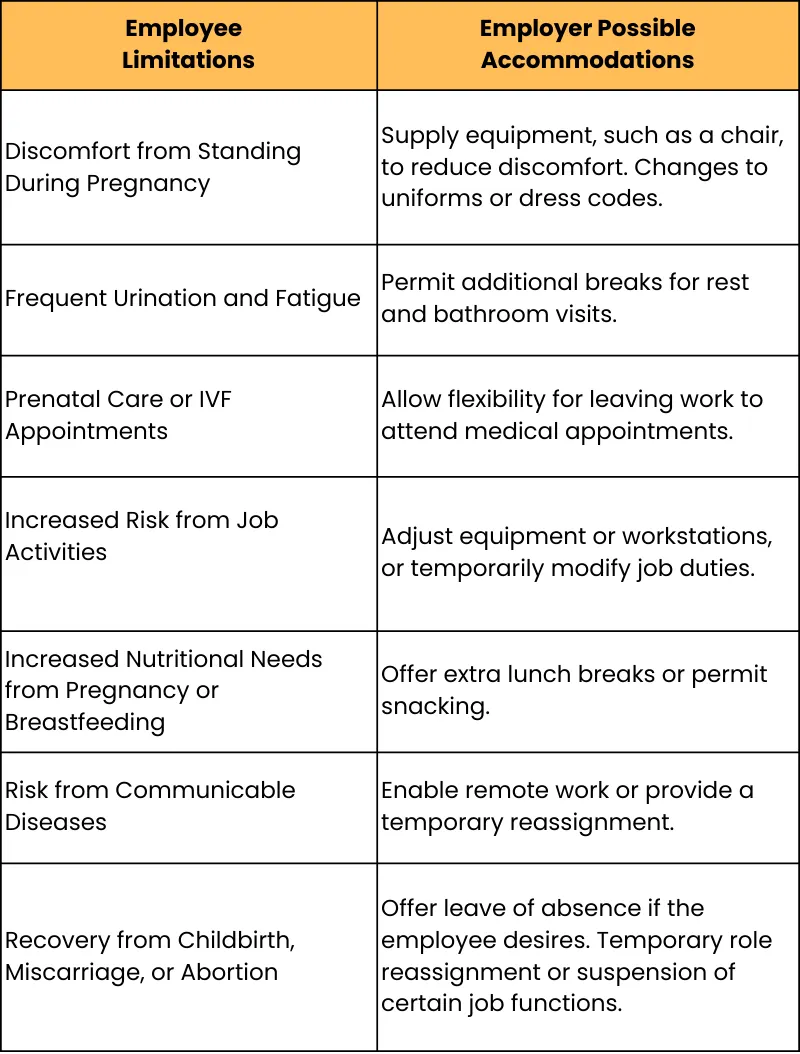
Employer Training Recommendations
Employers should train supervisors to efficiently handle accommodation requests. Unlike the ADA, the PWFA may allow temporary suspension of essential functions without specific accommodation language. Employers also cannot insist on medical examinations by a provider they select for those requesting accommodation.
Additional Relevant Laws
In addition to the PWFA, various laws protect pregnant employees and new parents from discrimination and unfair dismissal.
Key regulations include:
- Title VII of the Civil Rights Act: Prohibits discrimination based on pregnancy, childbirth, or related health conditions.
- Americans with Disabilities Act (ADA): Obligates employers to provide reasonable accommodations for disabilities, which may encompass certain pregnancy-related issues.
- Family and Medical Leave Act (FMLA): Offers eligible employees unpaid, job-protected leave for specific medical and family-related reasons.
- PUMP Act: Requires employers to provide regular breaks and a private area for employees to express breast milk during work hours.
Summary
The Pregnant Workers Fairness Act (effective June 2024) requires employers to offer reasonable accommodations for pregnant employees, those recovering from childbirth, and nursing mothers. This applies to companies with 15 or more employees, with some exceptions in Louisiana, Mississippi, and religious organizations.
Employees can simply state their needs without referencing the law, and employers should avoid imposing undue hardships or retaliating. Suggested accommodations include flexible schedules, extra breaks, and remote work options. Supervisors should be trained to handle requests effectively.
Other laws like Title VII, ADA, FMLA, and the PUMP Act also protect pregnant workers, ensuring accommodations and rights at work.
Manage policies and compliance easily on hrdeck.com platform. Take advantage of the tools and resources provided to help your business minimize legal risks and protect against employee claims.
HRdeck is a platform designed for HR teams and companies to manage policies, compliance and communication effectively. Our solution aids in complying with policies and regulations, thereby safeguarding from any penalties, liabilities and reputation.
Try hrdeck.com now!
References
[1] https://www.eeoc.gov/wysk/what-you-should-know-about-pregnant-workers-fairness-act
[2] https://www.eeoc.gov/statutes/pregnant-workers-fairness-act