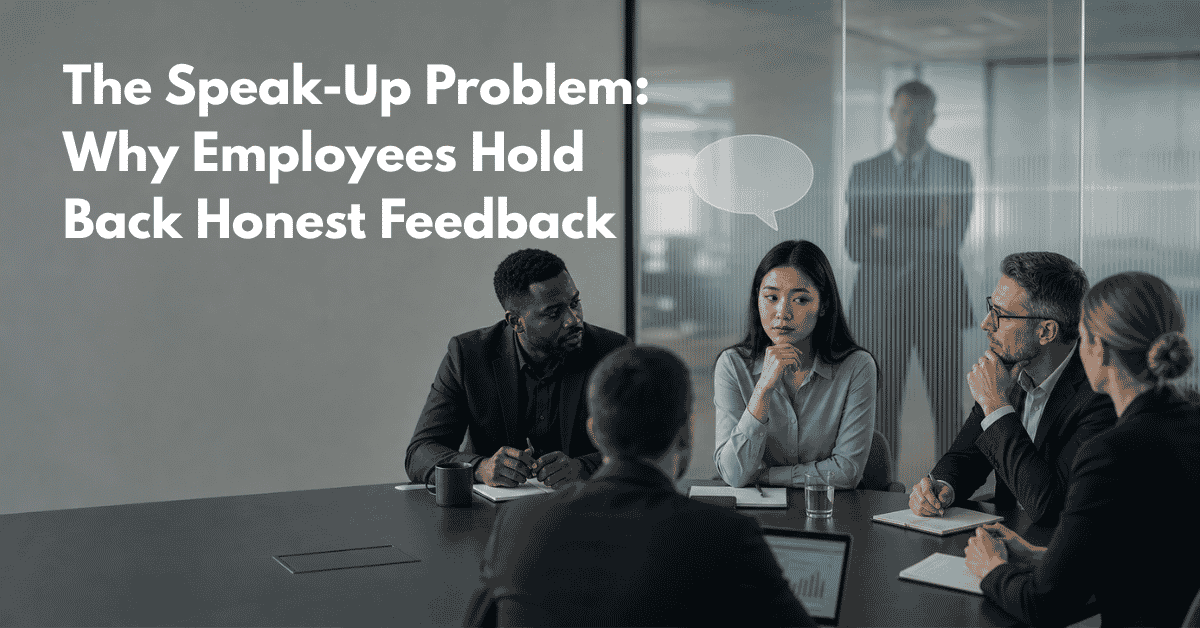
A recent survey from executive coaching firm Radical Candor found that 6 in 10 employees are afraid to speak up about concerns at work, highlighting a widening “trust gap” between leadership and staff. In the same research, 46% of executives said a lack of honest feedback across the company was their top concern, while 67% of HR leaders reported seeing employees stay silent about issues.[2][3][1]
This trust gap is not just about feelings; it shows up in the mechanics of feedback. Only 42% of U.S. employees say they have a formal opportunity to provide feedback to their manager, and just 24% report ever formally rating their manager’s performance. At the same time, 96% of employees believe regular feedback helps them improve, and 65% say they want more feedback than they currently receive — evidence that the appetite for open dialogue is there, but the systems and safety to support it are not.[5][6]
What “lack of honest feedback” looks like day to day
When employees do not feel safe to speak up, you see a pattern of silence, vague comments, and “sanitized” feedback that never touches real business problems. In Radical Candor’s research, more than 60% of respondents said they had seen colleagues stay quiet even when they disagreed or noticed issues, often because they feared retaliation or believed nothing would change.[3][7][1]
Even when feedback conversations do happen, they are often shallow or one‑sided. Only 16% of employees say their most recent feedback conversation felt “deeply meaningful,” and just 26% strongly believe the feedback they receive actually helps them do their jobs better. Feedback tends to flow downward from manager to employee, with only 36% of managers receiving any formal peer feedback and the majority of employees never asked how they prefer to be recognized or coached.[6][5]
Why employees stay silent
Fear of consequences and low psychological safety
Gallup’s research on psychological safety shows that many employees stay quiet because the perceived risk of speaking up feels higher than the benefit. Only about three in ten U.S. workers strongly agree that their opinions count at work — but Gallup estimates that raising that to six in ten could reduce turnover by 27%, cut safety incidents by 40%, and increase productivity by 12%.[7]
Employees who have seen colleagues punished, sidelined, or simply ignored after raising concerns quickly learn that silence is safer. In environments where layoffs and restructuring are common, people are even less likely to deliver uncomfortable truths — Kim Scott notes that in a climate of downsizing, many workers worry that being candid will put a target on their backs.[1][7]
Eroding trust in institutions and leaders
The broader trust climate is not helping. The 2026 Edelman Trust Barometer reports that seven in ten people globally are unwilling or hesitant to trust someone who holds different values or information sources, and nearly seven in ten respondents fear that institutional leaders are deliberately misleading the public. In this context, employees often extend their skepticism to corporate leaders, assuming that their concerns will be spun, minimized, or weaponized.[8]
Other data point to a simmering sense of grievance. Commentary on Gallup and Edelman’s 2025 reports notes that six in ten people across 28 countries say they feel moderately or highly aggrieved, believing that business and government mainly serve narrow interests while ordinary workers struggle. When employees start from a belief that leadership is “not on their side,” they are far less likely to volunteer honest feedback.[9]
Anxiety about AI and job security
Radical Candor’s report also connects feedback reluctance to the rapid introduction of AI into work. The study found that inaccuracies appear in AI-assisted work about 73% of the time, yet more than half of workers and managers say quality concerns about AI outputs are “only sometimes or rarely acted on.” Employees worry that raising concerns about AI tools or pointing out flaws could be interpreted as resistance to change, or worse, could accelerate automation that threatens their own jobs.[3][1]
In organizations where leaders talk about AI primarily as a cost-savings lever, employees are understandably cautious about offering frank feedback on how those tools are affecting quality, workload, or fairness.[1][3]
The business cost of silence
Disengagement and lost productivity
The silence around honest feedback feeds directly into disengagement. Gallup reports that U.S. employee engagement fell to a 10‑year low in 2024, with only 31% of employees engaged and 17% actively disengaged — numbers that match the worst levels seen in the past decade.[4]
HRdeck’s analysis of disengagement estimates that this disengagement now costs the U.S. economy around 2 trillion dollars in lost productivity annually, with disengaged employees being 18% less productive, 37% more absent, and associated with 23% lower profitability than their engaged peers. Workers who feel unheard and unable to give honest feedback are much more likely to drift into quiet quitting or outright withdrawal.[10][4]
Turnover and talent risk
Poor feedback environments also drive attrition. A recent study highlighted in Borderless AI’s 2026 summary found that people receiving low‑quality performance feedback were 63% more likely to leave than others, and 17% of respondents named insufficient feedback as a primary reason they were looking for new roles.[6]
Pew Research similarly notes declines in employees who are “extremely or very satisfied” with the amount of feedback they receive, linking this to broader drops in satisfaction with pay, benefits, and manager relationships. When employees are dissatisfied on multiple fronts and feel they cannot safely say so, many simply exit rather than fight for change internally.[11]
Compliance, culture, and reputational risk
Silence about concerns is not just a cultural issue — it can become a compliance and legal problem. Research on workplace misconduct and “speak up” culture describes a persistent “trust gap” where employees hesitate to report issues because they fear not being taken seriously or worry about retaliation. Many HR and compliance leaders are surprised that official complaint data significantly under-represents the actual level of misconduct employees report experiencing or witnessing.[12]
In states like California, where laws around harassment, workplace violence, and retaliation are tightening, failing to create safe feedback channels can expose employers to serious risk. For example, California guidance stresses that employers cannot use confidentiality gag orders to silence employees about factual information in harassment cases and must preserve complaint documentation for at least five years. New workplace violence legislation (SB 553) explicitly requires employers to explain how employees can report violence without fear of retaliation and to keep logs of violent incidents. If your culture discourages honest feedback, you are less likely to hear about these issues early — and more likely to face them later in a courtroom.[13][14]
Why managers struggle to invite honest feedback
The trust gap is not just about employee courage; it is also about manager capability. Radical Candor’s survey found that roughly 70% of respondents had never been taught how to solicit or give feedback before becoming managers. More than 70% of managers in the study said they rarely or never had opportunities to practice feedback skills before taking on leadership roles, and many admitted they become defensive or punitive when confronted with criticism.[3][1]
Meanwhile, the systems that are supposed to support feedback are widely distrusted. More than 75% of HR leaders believe annual performance reviews do not accurately reflect employee contributions, and over 90% of managers report frustration with traditional review processes. In practice, this means many managers go through the motions of annual reviews without building a habit of regular, two‑way coaching conversations.[6]
Only 1 in 5 employees receives feedback weekly, even though about half of managers believe they are giving feedback “often” — a perception gap that further erodes trust. And because feedback flows overwhelmingly top‑down, managers rarely hear how their own behavior is landing, making it harder for them to improve their listening and response skills.[5][6]
For small organizations and nonprofits, these problems are often compounded by resource constraints. Nonprofit employers, for example, face the same legal and cultural requirements as for‑profit organizations but often manage HR on lean budgets and with leaders who juggle HR alongside finance, operations, and fundraising. Without dedicated HR capacity, it is easy for manager training and feedback infrastructure to lag behind growth.[15]
How policies and handbooks can help — or hurt
Employee handbooks are often the first place employees look to understand expectations and protections around speaking up, but many handbooks are not designed for that purpose. HRdeck notes that handbooks are frequently overloaded with legal jargon and compliance language, making them confusing and discouraging for employees to read. When policies are written primarily from the organization’s perspective, rather than focusing on what employees need to understand, employees are less likely to see them as a support for honest feedback.[16]
Many handbooks also over‑index on dictating behavior and under‑index on values, leaving little room to set clear expectations that employees have both the right and the responsibility to raise concerns. HRdeck recommends using a simple, plain‑language page to set expectations about maintaining a healthy work environment, including an employee’s responsibility around feedback and how the organization will protect people who speak up.[16]
On the compliance side, policies must clearly communicate anti‑retaliation protections, reporting channels, and the organization’s commitment to taking concerns seriously — whether they involve harassment, safety, ethical issues, or the impact of AI on work. When employees can see this spelled out in language they understand, it becomes easier for them to believe that leadership actually wants to hear the truth.[14][13]
Practical steps to unlock honest feedback
1. Diagnose your feedback “trust gap”
Start by making the invisible visible. Run short, anonymous pulse surveys that ask very specific questions, such as:
· “Do you feel safe raising concerns with your manager?”
· “Have you seen someone experience consequences for speaking up?”
· “Do you have a clear channel to give feedback about your manager?”
Given that only 42% of employees currently report having a formal opportunity to provide feedback to their manager, you should assume that your default state is under‑listening unless you have consciously built robust channels. Track not only participation rates but also changes in trust signals over time — for example, the share of employees who strongly agree their opinions count at work.[7][5]
2. Treat psychological safety as a core operational metric
Psychological safety is not a “soft” idea; it is strongly correlated with engagement, productivity, and safety outcomes. Make psychological safety a named goal in your people strategy, and tie it to concrete behaviors:[7]
- Leaders acknowledging when they were wrong.
- Managers thanking employees for critical feedback and explaining what will happen next.
- Teams conducting “after‑action” reviews where people can share what went wrong without blame.
Gallup’s research suggests that moving the proportion of employees who feel their opinions count from three in ten to six in ten could significantly reduce turnover and incidents while boosting productivity. That is the business case for investing in safety, not just compliance.[7]
3. Rewrite your handbook to invite voice
Audit your employee handbook with one question in mind: “If I were a new hire, would this document convince me it is safe and expected to speak up?” Many small businesses find that their handbooks emphasize rules and risks far more than values and voice.[16]
Consider:
- Adding a one‑page “feedback charter” that explains why feedback matters, how employees can provide it, and how the company will respond.[16]
- Using plain language instead of legalese and organizing sections from the employee’s perspective (“How to raise a concern,” “What happens after you report something,” “How we protect you from retaliation”).[13][16]
- Aligning your handbook with state requirements on reporting harassment, workplace violence, and retaliation, so employees know their rights and your obligations.[14][13]
When the handbook clearly reinforces that employees are partners in shaping the culture — not just subjects of policy — they are more likely to use it as a springboard for honest conversation.
4. Train managers in two‑way feedback and Radical Candor
Given that 70% of people in Radical Candor’s survey had never been taught how to give or solicit feedback before becoming managers, you cannot assume managers will “figure it out” on their own. Training should cover both skills and mindsets.[3]
The Radical Candour framework, developed by Kim Scott, is built on two dimensions: caring personally and challenging directly. Managers who care personally show genuine interest in their employees as human beings; managers who challenge directly are willing to say the hard thing clearly, without sugarcoating or passive‑aggression.[17]
Apply that same framework to upward feedback:
- Invite challenge directly: Have managers explicitly ask their teams, “What is one thing I could do differently to support you better?” and sit in silence long enough to get a real answer.
- Show care in the response: Train managers to thank employees for their honesty, avoid defensiveness, and follow up later with what they did as a result.
When employees see that feedback is both requested and acted upon, their willingness to share more honest input grows over time.[1][7]
5. Modernize performance and feedback systems
The data on performance reviews are clear: most people do not trust them. More than 75% of HR leaders believe annual reviews fail to capture real contributions, and over 90% of managers report frustration with traditional review processes. At the same time, only 23% of U.S. employees strongly agree they received meaningful feedback in the past week, despite strong evidence that frequent recognition dramatically boosts perceived value and engagement.[18][6]
To close that gap:
- Move from annual to ongoing feedback, using brief monthly or bi‑weekly check‑ins.
- Build structured upward feedback into review cycles so employees can formally rate and comment on their managers at least once a year.[5]
- Train managers to tailor feedback to employees’ career goals, since half of employees say their manager does not adjust feedback to their aspirations.[6]
Employees overwhelmingly say they want more feedback and that they appreciate both positive and negative feedback, but only 26% feel the feedback they get actually helps them improve. The goal is not just “more feedback,” but better, more actionable feedback delivered in both directions.[6]
6. Align speak‑up culture with compliance expectations
As state and local regulations evolve — especially in jurisdictions like California — leaders need to connect their culture work with their compliance responsibilities. California law emphasizes transparent reporting channels, non‑retaliation, and proper documentation for harassment, safety issues, and now workplace violence.[19][13][14]
In practice, this means:
- Making sure reporting procedures are clearly described in handbooks and training.[13][16]
- Training supervisors that failing to address harassment or safety complaints can create personal liability, not just organizational exposure.[13]
- Embedding “no retaliation” commitments into manager expectations and performance criteria, not just policies.[14][13]
When your culture and your compliance program both send the same message — “We want to hear concerns, and here is how we will protect you when you raise them” — employees are more likely to believe you.[12][13]
7. Use AI transparently and invite feedback about it
Given that inaccuracies are found in AI‑assisted work roughly 73% of the time, organizations should treat employee feedback about AI as a critical quality control mechanism, not a nuisance. Make it explicit that you want employees to flag AI errors, bias, or workflow issues and that doing so will not put their jobs at risk.[1][3]
Leaders can:
- Share how AI decisions are made and where human judgment still prevails.
- Create clear channels (for example, a specific tag or form) for reporting AI issues.
- Publicly recognize teams that catch and correct AI‑driven problems.
This not only improves the technology but also signals that honest feedback — especially about sensitive topics like automation — is valued.[3]
Summary
The lack of honest feedback from employees is not a personality problem; it is a systems, skills, and trust problem. The research is clear that when organizations close the trust gap — by building psychological safety, training managers, modernizing feedback systems, and aligning handbooks and policies with a true speak‑up culture — they unlock engagement, innovation, and resilience. For leaders and HR teams, the question is no longer whether you can afford to hear the truth, but whether you can afford not to.[10][4][7]
Want to manage your policies & employee handbook more effectively?
HRdeck is a platform designed for HR teams and companies, especially small businesses and nonprofits, to manage policies, compliance, and communication more effectively. Our solution helps organizations stay aligned with workplace policies and regulations, reducing the risk of penalties, liabilities, and reputational harm. Take advantage of the tools and resources available to help your business minimize legal risks and protect against employee claims.
Try hrdeck.com now.
REFERENCES
2. https://www.radicalcandor.com/trust-gap
4. https://www.gallup.com/workplace/654911/employee-engagement-sinks-year-low.aspx
5. https://peacefulleadersacademy.com/employee-feedback-statistics/
6. https://www.hireborderless.com/post/employee-feedback-statistics
7. https://www.gallup.com/workplace/236198/create-culture-psychological-safety.aspx
8. https://capitolcommunicator.com/edelman-trust-barometer-finds-reshaping-of-trust-and-leadership/
10. https://hrdeck.com/an-employers-guide-employee-disengagement-quiet-quitting-and-quiet-cracking/
11. https://www.pewresearch.org/social-trends/2024/12/10/job-satisfaction/
12. https://maritimesafetyinnovationlab.org/wp-content/uploads/2021/11/The-Trust-Gap-Report.pdf
13. https://hrdeck.com/california-small-businesses-avoid-compliance-risks-in-2026/
14. https://hrdeck.com/navigating-california-sb553-law-employers-tips/
15. https://hrdeck.com/nonprofit-hr-compliance-risks-and-pain-points-in-2026/
16. https://hrdeck.com/employee-handbook-gaps-how-to-avoid-them/
17. https://peopleinsight.co.uk/radical-candour/
18. https://high5test.com/employee-satisfaction-statistics/
19. https://hrdeck.com/avoid-costly-compliance-mistakes-in-2026-compliance-risks-in-2026/
20. https://hrdeck.com/index.php/2023/10/02/employee-handbook-gaps-how-to-avoid-them/
21. https://hrdeck.com/2025-state-labor-law-updates-for-u-s-small-businesses/
22. https://hrdeck.com/8111060175.htm
24. https://www.edelman.com/trust/2022-trust-barometer/special-report-trust-workplace