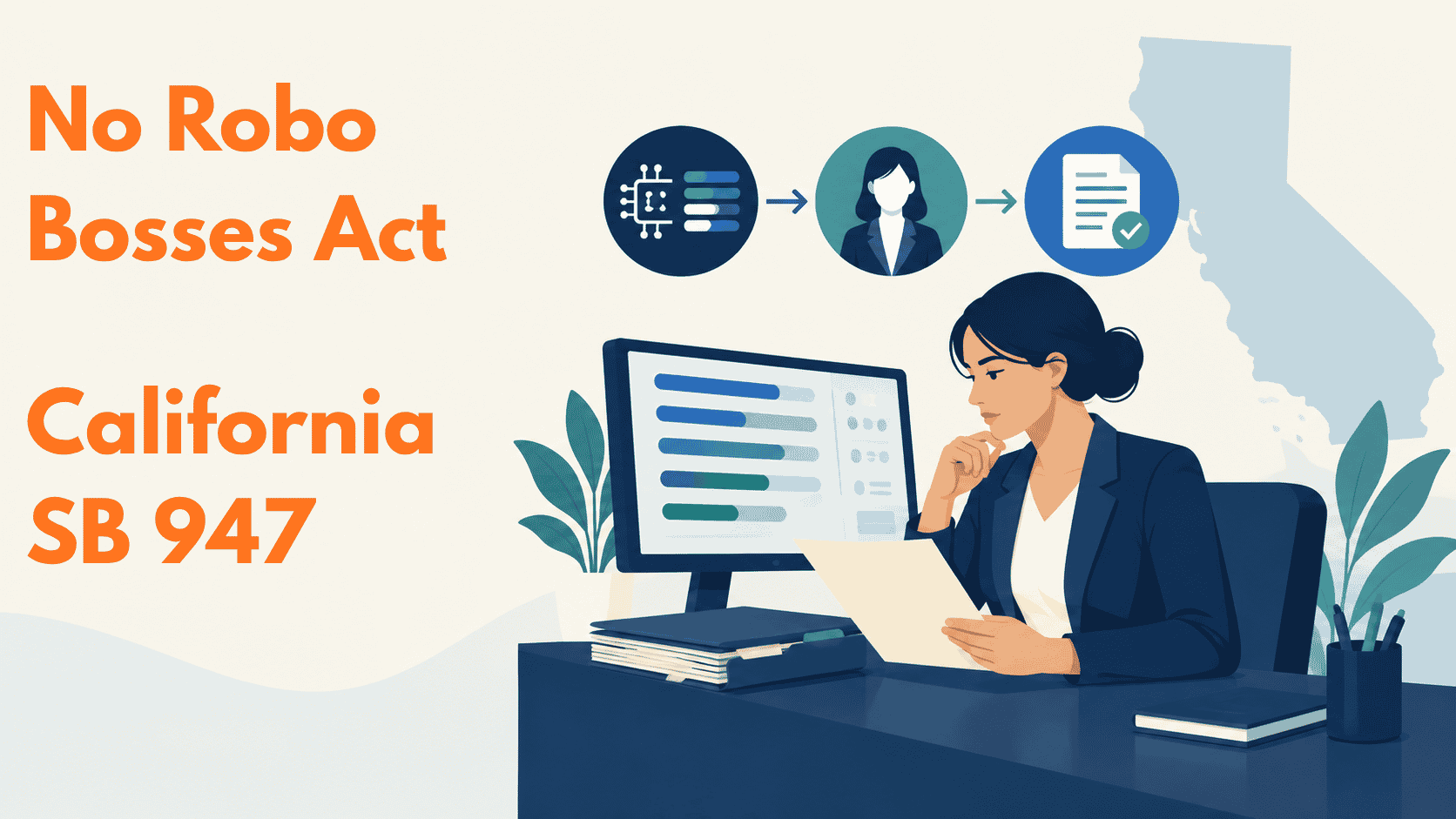
California’s new workplace automation law requires more than a human clicking “approve.” Employers need a process for corroborating automated recommendations, notifying employees, and documenting what actually happened.
Technology can flag declining productivity, identify attendance patterns, and recommend disciplinary action. But beginning July 1, 2027, California employers cannot rely solely on an automated decision system to discipline or terminate an employee. When they primarily rely on an automated recommendation, they must meet specific human-review and employee-notice requirements.leginfo.legislature.ca
Signed September 30, 2026, SB 947 adds California Labor Code §§ 1520–1526.7. Often called the “No Robo Bosses Act,” it places human corroboration at the center of consequential employment decisions.leginfo.legislature.ca+1
For employers, the preparation challenge is operational: identify affected systems, change decision workflows, prepare notices, train reviewers, and establish reliable documentation. HRDeck can be evaluated as part of that implementation approach — but technology supports compliance; it does not replace legal judgment or responsible management.
Who Must Comply?
SB 947 does not use the CCPA’s revenue or data-volume thresholds. It broadly defines an employer as a person who employs or exercises control over another person’s wages, hours, or working conditions, directly or through an agent. The statute sets no minimum employee count.leginfo.legislature.ca
The definition expressly includes governmental entities, labor contractors, farm labor contractors, and foreign labor contractors. It includes the California State University and community college districts; University of California coverage is subject to agreement by the regents.leginfo.legislature.ca
Consequently, small employers should not assume they are exempt simply because California’s privacy-based ADMT requirements do not apply to them.
There are narrow exceptions. A collective bargaining agreement must explicitly and unambiguously waive the law, address specified employment terms, and provide protection from algorithmic management. Another exception concerns certain federally required or reasonably necessary aerospace, national-security, military, space, and defense uses — but only the covered operations.leginfo.legislature.ca
What Counts as an Automated Decision System?
SB 947 defines an automated decision system, or ADS, broadly. It includes computational processes derived from machine learning, statistical modeling, data analytics, or artificial intelligence that produce simplified outputs — such as scores, classifications, or recommendations — used to assist or replace human discretionary decisions and materially affect people.leginfo.legislature.ca
This is not limited to generative AI or fully autonomous software. A recommendation engine inside an existing workforce platform may qualify even when a manager makes the final decision.
The statute excludes spam filters, firewalls, antivirus software, identity and access management tools, calculators, databases, datasets, and other compilations of data.leginfo.legislature.ca
The distinction matters: storing attendance records in a database is different from using an analytical system to convert those records into a disciplinary recommendation.
The Core Rule: No Discipline or Termination Based Solely on ADS
The law’s central prohibition is straightforward: an employer cannot rely solely on an ADS when making a disciplinary or termination decision.leginfo.legislature.ca
Employers that primarily rely on ADS output must direct a human to corroborate the decision using the data collected or used to generate the output, or other relevant supporting information. The statute identifies examples including managerial evaluations, personnel files, employee work product, peer reviews, and witness interviews, which may include relevant online customer reviews.leginfo.legislature.ca
This is not a requirement to produce a second automated score. It requires examination of evidence.
If the employer cannot corroborate the output — or the reviewer concludes it is inaccurate, incomplete, or misleading — the employer cannot use that output to make the disciplinary or termination decision.leginfo.legislature.ca
The statute does not define “primarily” through a numerical threshold. Employers should therefore document the output’s actual role rather than inventing a percentage-based test. Paul Hastings also identifies the meaning of “primarily” and the scope of “disciplinary decision” as unresolved interpretive issues.paulhastings
What Human Corroboration Looks Like in Practice
Consider an illustrative example: a productivity platform flags an employee for termination because recorded activity fell below a threshold.
A superficial process would involve a supervisor accepting the score and signing a termination form.
A more substantive review would examine whether the system captured the relevant work, whether the underlying records were accurate, and whether other evidence supports the proposed action. Perhaps the employee was assigned offline work that the platform did not measure. Perhaps a system outage distorted the results.
Under SB 947, an output found incomplete or misleading cannot be used for the disciplinary or termination decision.leginfo.legislature.ca
As a recommended implementation control, employers should document:
- The proposed decision and the ADS output.
- The underlying data or supporting evidence reviewed.
- Any errors, omissions, or limitations.
- The reviewer’s corroboration findings.
- The final determination and approving official.
These are practical documentation fields, not a statutory form.
Employees Must Receive a Standalone Notice
When an employer primarily relies on ADS for discipline or termination, it must provide a written post-use notice when informing the employee of the decision.leginfo.legislature.ca
The notice must be a separate, standalone communication, written in plain language and in the language used for routine employee communications. Delivery must use a simple method, such as email, a hyperlink, or another written format.leginfo.legislature.ca
It must explain:
- That the employer primarily relied on ADS.
- That a human reviewed the decision and corroborated the output.
- How to contact a human for more information, including the employee’s right to a description of their own data used by the ADS.
- That retaliation for exercising rights under the law is prohibited.leginfo.legislature.ca
A generic handbook acknowledgment does not replace this decision-specific notice. Employers need a delivery step built into the actual disciplinary or termination workflow.
Prepare for Employee Data Requests and Protected Activity
An employee may request a meaningful, objective description of their own data used by the ADS when the employer primarily used it for discipline or termination. The employer must provide the description while anonymizing other individuals’ personal information.leginfo.legislature.ca
The statute does not establish a fixed response period for this request. Employers should adopt a prompt internal process without misrepresenting that internal target as a statutory deadline.
SB 947 also prohibits ADS uses that violate applicable labor, employment, safety, or civil rights requirements; infer an employee’s protected status; or predict and take adverse action against workers for exercising legal rights. It separately protects employees from retaliation for invoking or assisting enforcement of their SB 947 rights.leginfo.legislature.ca
Preparation must therefore include feature review and manager conduct — not just notice templates.
A Practical Preparation Roadmap
The following schedule is a recommended implementation plan, not a set of statutory milestones.
Before Year-End 2026: Identify Systems and Owners
Inventory systems that contribute to discipline or termination, including monitoring, attendance, productivity, and performance tools.
Record each tool’s purpose, inputs, outputs, vendor, owner, and actual decision-making role. Have counsel assess coverage and any claimed exception.
January–March 2027: Redesign Decision Workflows
Remove workflows that rely solely on ADS for discipline or termination.
Create a corroboration procedure, establish the “do not use” rule for unreliable outputs, and identify who can stop a decision. Review whether vendors provide enough information to support these duties.
April–May 2027: Prepare Notices and Train Reviewers
Approve standalone notices and translations. Establish a human contact for employee questions and a process for preparing data descriptions.
Train reviewers using realistic examples. Focus on evidence evaluation, accurate documentation, confidentiality, and non-retaliation.
June 2027: Test Before Launch
Run sample cases from recommendation through corroboration, decision communication, notice delivery, and employee request handling.
Close critical gaps before July 1. A completed policy is not the same as a working process.
Where HRDeck Can Support Implementation
The useful question is not whether HRDeck can “make the company compliant.” It is where available HRDeck capabilities fit into the organization’s approved operating process.
Bring the corroboration workflow, notice requirements, and documentation needs into a product evaluation. Ask the HRDeck team to demonstrate how current functionality could support your intended approach.
Priority evaluation areas include:

These are requirements to evaluate — not claims that every feature is currently available.
The strongest implementation uses HRDeck alongside legal review, vendor due diligence, appropriate technical controls, and trained managers. A workflow-focused demo can help distinguish product support, configuration needs, integrations, and responsibilities that remain with the employer.
Why Documentation Matters
SB 947 authorizes enforcement by the Labor Commissioner and public prosecutors and establishes a $500 civil penalty per violation. It also includes a burden-shifting provision in specified proceedings: after ADS use in a disciplinary or deactivation decision is demonstrated, the employer must show that it did not primarily rely on ADS or that it complied with the corroboration and notice requirements.leginfo.legislature.ca
Employers should preserve accurate evidence of the process. Do not rewrite an ADS-led decision as entirely manual.
SB 947 itself does not establish a universal four- or five-year retention rule. Apply a record-specific schedule addressing other applicable laws and legal holds. It also preserves applicable CCPA privacy-related ADMT regulations, so satisfying SB 947 does not eliminate separate privacy obligations.leginfo.legislature.ca
Start with One Workflow — Then Make It Repeatable
July 1, 2027 should be the completion point for readiness, not the day employers begin investigating their systems.
Start with one consequential workflow. Identify the technology, establish human corroboration, prepare the notice, and test the response process. Then extend the approach consistently.
Explore how HRDeck can support your approved procedures and documentation needs through a workflow-focused demonstration. The objective is a process your team can follow — and explain when a decision is questioned. https://hrdeck.com
References
- California Legislature, SB 947, Chapter 859, Statutes of 2026: primary authority for Labor Code §§ 1520–1526.7, including scope, prohibited uses, corroboration, notices, requests, enforcement, exceptions, and the operative date.leginfo.legislature.ca
- Paul Hastings, “Gov. Gavin Newsom Signs New AI Laws Affecting California Employers,” October 15, 2026: secondary analysis of SB 947 and implementation questions. The statutory text controls where summaries differ.