What off-the-clock work means
Under the Fair Labor Standards Act (FLSA), covered nonexempt employees must be paid at least minimum wage for all hours worked and overtime at one and one-half times their regular rate for hours over 40 in a workweek. “Hours worked” is broadly defined to include all time an employee must be on duty or at a prescribed workplace, plus any additional time they are allowed, suffered, or permitted to work, even if the work was not requested.[5][6][7]
Off-the-clock work occurs when a nonexempt employee performs job-related tasks without recording the time and therefore without being paid. Common examples include answering emails before a shift, finishing tasks after clocking out, handling calls during unpaid meal breaks, or addressing urgent issues at night or on weekends. It can also include pre- and post-shift activities such as walking long distances inside a facility to reach a time clock or going through mandatory security screenings when that time is not captured and paid.[1][2][8][9][4][6][10]
Why small minutes become big cases
Individually, a few unpaid minutes per day might seem insignificant, and the FLSA does recognize a narrow “de minimis” concept for truly infrequent, tiny increments that cannot be practically recorded. However, regulators emphasize that employers may not arbitrarily ignore regular, identifiable work time just because each chunk is small; if time can be practically tracked and is part of an employee’s normal duties, it must be counted and paid.[9][6][7]
When those “quick emails” and “short calls” are repeated across dozens or hundreds of employees, week after week, the unpaid time can translate into substantial back wages and overtime. That is why off-the-clock cases are so often filed as class or collective actions under federal and state wage-and-hour laws, allowing many employees to combine relatively small individual claims into a single, high-impact lawsuit. In addition to unpaid wages, employers may face liquidated (double) damages under the FLSA, attorneys’ fees, and separate statutory penalties under more protective state laws.[1][2][8][3][4]
Real-world settlements show the scale of the risk. For example, class actions over unpaid off-the-clock work and missed meal breaks have led to employer settlements in the tens and hundreds of millions of dollars, including a reported settlement exceeding 350 million dollars involving alleged off-the-clock and meal-break violations at a major national retailer. Another recent case involved a large employer agreeing to pay 4.6 million dollars to resolve claims that employees were not paid for time walking to distant time clocks and completing pre- and post-shift security screenings.[4][10]
Remote and hybrid work amplify exposure
Roughly one in five workers in the United States now work remotely, and projections suggest more than 32 million Americans — about 22 percent of the workforce — could be working remotely by 2025. While flexibility has benefits, it also makes it harder for managers to see when nonexempt employees are actually working, blurring the line between paid and unpaid time and increasing the risk of off-the-clock work.[11][2][8][12]
The U.S. Department of Labor has issued updated guidance on tracking compensable hours for remote nonexempt employees, stressing that employers are responsible for paying for all hours they know or have reason to know are being worked. Even if work is done outside scheduled hours or in violation of company policy, employers must still compensate the time if they had actual or constructive knowledge of the work. That includes time spent on tasks that may seem informal or brief: responding to after-hours emails or messages, monitoring collaboration tools, logging in on weekends to “catch up,” or working through meal breaks.[2][5][8][4][11]
Remote workforces also tend to be geographically dispersed, sometimes spanning multiple states with different overtime rules, break requirements, and recordkeeping obligations, which can compound compliance risk. Without accurate information about where employees are working and when they are on the clock, multi-state employers can easily slip out of alignment with local wage-and-hour requirements.[8][12][2]
Automation Tools
As more organizations experiment with generative AI and automation tools, the pattern of off-the-clock work is also shifting. Some employees may use AI tools off hours to draft emails, summarize documents, or prep deliverables, effectively doing unpaid work that benefits the employer. At the same time, properly deployed AI and automation can reduce administrative workload and help employees complete tasks within scheduled hours, which may lower the overall volume of overtime and related claims.[2][8][12]
For HR and legal teams, the key is not the technology itself but how it is used and monitored. Timekeeping policies and training should make clear that all work done, including work aided by AI tools, must be recorded, and systems should make it easy to log that time from any device or location. Employers should also be alert to the risk that AI-enabled productivity expectations may indirectly pressure employees to “catch up” off the clock, especially in lean teams or high-demand roles.[13][11][5][8][2]
The legal standard for liability
Under the FLSA, employers must pay nonexempt employees for all hours they are suffered or permitted to work, regardless of whether the work was authorized. Courts and the Department of Labor distinguish between an employer’s actual knowledge (for example, a manager directly observing or assigning work) and constructive knowledge (what the employer reasonably should have known, given available information and systems).[11][2][5][8][4]
Ignorance is not a defense when employers have tools that could reveal off-the-clock work, such as email and messaging logs, system access reports, or time records showing repeated variances around start and end times. Employers can discipline employees for performing unauthorized work outside scheduled hours, but they cannot withhold pay for that time once they know or should know that the work occurred.[2][5][8][4][11]
State laws can go further than the FLSA, especially around meal and rest breaks. For example, some states require specific meal and rest periods for nonexempt employees and impose financial penalties when those breaks are missed, shortened, or interrupted. In such jurisdictions, employees who work through required breaks — whether in the office or while working from home — may be entitled not only to wages for the time worked but also to separate premium payments or penalties.[14][15][2]
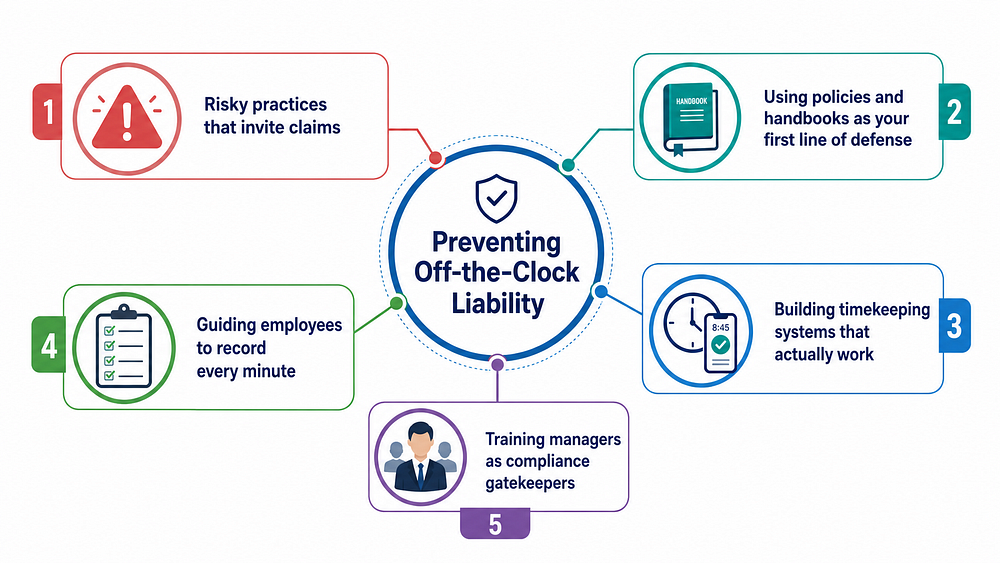
- Risky practices that invite claims
Certain common timekeeping and scheduling practices are particularly likely to generate off-the-clock allegations:
· Allowing employees to pre-populate timesheets or only report exceptions to their schedule, rather than recording actual hours worked day by day.[1][2]
· Automatically deducting meal periods from time records, regardless of whether the employee actually took an uninterrupted break.[9][6][1]
· Expecting or informally encouraging employees to check email, messages, or systems after hours, without recording the time.[2][8][4]
· Requiring employees to complete pre- or post-shift tasks — like security screenings, equipment checks, or extensive walking to reach time clocks — without capturing that time.[6][10][9]
· Misclassifying employees as exempt from overtime when their actual duties do not meet exemption criteria, particularly in remote or hybrid roles where day-to-day work is less visible.[8][3][2]
These practices not only undermine trust but also create a record trail that plaintiffs’ attorneys and regulators can use to argue that off-the-clock work was systemic, not incidental. Once a pattern is established, it becomes much easier for employees to pursue classwide or collective remedies.[4][1][2]
2. Using policies and handbooks as your first line of defense
A well-designed employee handbook is a powerful tool for setting clear expectations about timekeeping, overtime, breaks, and off-the-clock work. It should explain in plain language how employees should record their time, what counts as compensable work, and how to raise concerns about unpaid wages or missed breaks without fear of retaliation.[16][17][4]
Handbooks and written policies can also help demonstrate that the organization communicated its legal obligations and provided a consistent framework across locations, which can be valuable if a dispute arises. However, a policy that looks good on paper but is ignored in practice offers little protection; plaintiffs will compare the written rules to what managers and employees actually do day to day.[18][17][1][2][4][16]
To align policy with reality, employers should:
· Include a clear prohibition on off-the-clock work and a statement that all hours worked will be paid, even if not preapproved.
· Require employees to accurately record all time worked, regardless of where or when the work occurs.[11][2][5]
· Explain the process for requesting overtime and reporting errors or concerns with paychecks or time records.
· Emphasize anti-retaliation protections for employees who raise concerns about wages or hours.[3][4]
3. Building timekeeping systems that actually work
Technology can support compliance, but only if it is accessible, user-friendly, and aligned to modern work patterns. In a remote or hybrid environment, employees need the ability to record time from mobile devices, laptops, or shared workstations, not just physical time clocks in a central location.[11][2][8]
The Department of Labor has highlighted that employers must exercise reasonable diligence in tracking working time, which includes providing mechanisms for employees to report unscheduled or off-hours work. Cloud-based timekeeping systems that allow real-time entry, capture changes in schedules, and flag unusual patterns can help HR teams spot potential off-the-clock issues early. When paired with regular audits — comparing time records against communication logs, system access reports, and payroll data — these systems can reveal gaps that might otherwise go unnoticed.[18][14][2][5][8][11]
For organizations with auto-deduct meal breaks or exception-based reporting, routine validation is especially important. Employers should periodically survey employees or conduct spot checks to confirm that auto-deducted breaks are truly being taken and that exception-based systems are not masking regular off-the-clock work. Regular verification that employees and managers both understand the system and use it consistently is critical.[1][9][6]
4. Guiding employees to record every minute
Employees usually do not set out to violate wage-and-hour rules; more often, they are trying to keep up with workload or meet perceived expectations. That is why clear, practical guidance for nonexempt employees is essential to reducing off-the-clock risk.[13][19]
Training and ongoing reminders should:
· Explain what counts as work, including “quick” tasks like answering emails, sending messages, or logging into systems.[1][2][8]
· Reinforce that the company wants all time worked recorded and will pay for it, even if the work was not preapproved.
· Clarify that employees are not allowed to “volunteer” extra time, work through unpaid breaks, or make up time off the clock to avoid overtime.
· Encourage employees to speak up if they feel pressured to work without recording time and provide anonymous channels for raising concerns when necessary.[19][4]
Employers can also build simple prompts into everyday workflows — such as end-of-day check-ins, weekly time verification, or periodic reminders — to nudge employees to review and confirm the accuracy of their hours.[11][2]
5. Training managers as compliance gatekeepers
Supervisors and frontline managers are often the single biggest factor in whether off-the-clock policies are followed or ignored. They assign work, set expectations around responsiveness, and approve time records, so their behavior sends a strong signal about what the organization truly values.[13][19]
Manager training should emphasize that:
· They must never discourage employees from reporting all hours worked, even if overtime budgets are tight.[11][2][8]
· They may not ask or allow nonexempt employees to work outside scheduled hours without ensuring that time is recorded and paid.[5][4][11]
· They should not “rubber stamp” timesheets; instead, they should review patterns, ask questions about unusual hours, and follow up on indicators that off-the-clock work may be occurring.[2][11]
· While they can enforce rules against unauthorized overtime through discipline, they still must approve pay for all time actually worked.[4][11][5]
Equipping managers with scripts and scenarios — for example, how to respond when an employee mentions working late without logging time, or how to handle repeated after-hours emails from a nonexempt team member — can turn abstract legal requirements into practical behavior change.[19][13]
A practical checklist for employers
To reduce off-the-clock liability, HR and business leaders can use the following checklist as a starting point:
- Confirm which employees are properly classified as nonexempt and ensure their job duties still match that classification in a remote or hybrid setting.[2][8][3]
- Review and update handbooks and policies to clearly address off-the-clock work, overtime approval, remote work expectations, and break requirements, reflecting both federal and applicable state and local laws.[14][16][15]
- Evaluate timekeeping systems for remote accessibility, ease of use, and ability to capture unscheduled work and work across devices.[11][8][2]
- Audit high-risk practices such as auto-deducted meal periods, exception-only time reporting, and pre- or post-shift activities to ensure all compensable time is captured.[1][9][6][10]
- Provide regular training for employees and managers focused on what counts as work, how to record time, and how to raise concerns.
- Conduct periodic wage-and-hour compliance reviews, especially when expanding remote work, entering new jurisdictions, or making significant changes to schedules, staffing, or technology.[15][8][14]
By treating accurate timekeeping as both a legal requirement and a core element of employee trust, businesses can reduce the risk of costly off-the-clock claims while signaling to their workforce that every minute of their labor is valued.[18][16][2]
Want to manage your policies & employee handbook more effectively?
HRdeck is a platform designed for HR teams and companies, especially small businesses and nonprofits, to manage policies, compliance, and communication more effectively. Our solution helps organizations stay aligned with workplace policies and regulations, reducing the risk of penalties, liabilities, and reputational harm. Take advantage of the tools and resources available to help your business minimize legal risks and protect against employee claims.
Try hrdeck.com now.
References
4. https://www.classaction.org/off-the-clock-work-lawsuits
5. https://www.dol.gov/agencies/whd/flsa/off-the-clock
6. https://webapps.dol.gov/elaws/whd/flsa/hoursworked/screenee29.asp
7. https://webapps.dol.gov/elaws/whd/flsa/hoursworked/screenEE29.asp
8. https://www.jdsupra.com/legalnews/remote-work-and-wage-hour-compliance-8317358/
9. https://webapps.dol.gov/elaws/whd/flsa/hoursworked/screenEr29.asp
12. https://www.forbes.com/advisor/business/remote-work-statistics/
13. https://hrdeck.com/record-layoffs-record-burnout-what-employers-owe-their-hr-teams/
14. https://hrdeck.com/avoid-costly-compliance-mistakes-in-2026-compliance-risks-in-2026/
15. https://hrdeck.com/california-small-businesses-avoid-compliance-risks-in-2026/
16. https://hrdeck.com/the-essentials-of-an-employee-handbook/
17. https://hrdeck.com/employee-handbook-gaps-how-to-avoid-them/
18. https://hrdeck.com/category/blog/
19. https://hrdeck.com/the-speak-up-problem-why-employees-hold-back-honest-feedback/
20. https://hrdeck.com/understanding-pregnant-workers-fairness-act-pwfa/
22. https://hrdeck.com/gen-z-at-work-misunderstood-misread-and-led-the-wrong-way/
23. https://www.jacobslegal.com/p/off-the-clock-overtime-when-quick-questions-cost-you-big
24. https://www.bls.gov/osmr/research-papers/2023/pdf/ec230050.pdf