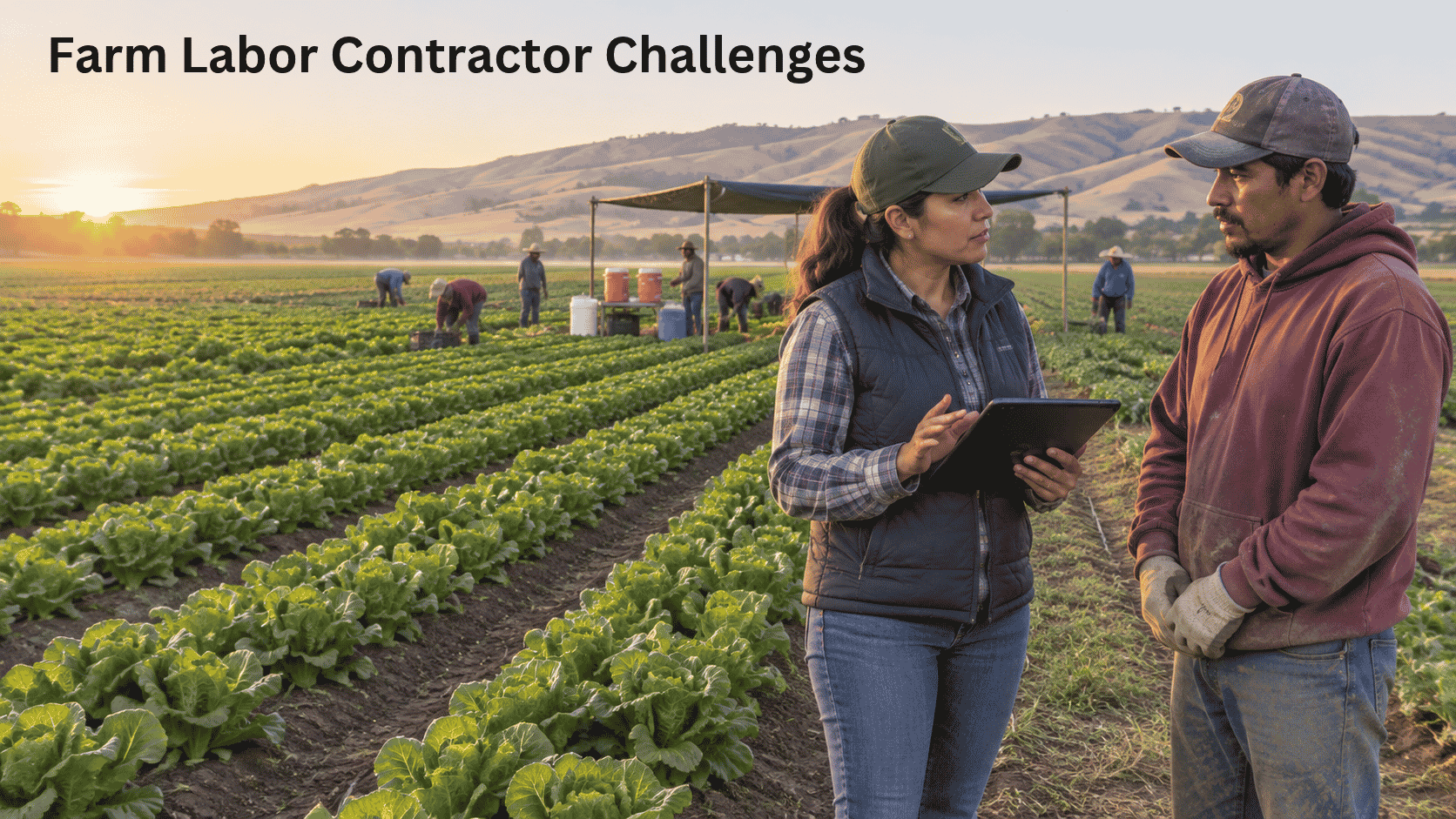
Running a California farm labor contractor (FLC) business means paying crews accurately, keeping workers safe at changing job sites, and being able to show what happened when a worker, grower, or regulator asks. In 2027, higher surety bond requirements, a new wage floor for certain H-2A and corresponding workers, and new restrictions on automated employment decisions add to the planning list.
1. Get piece-rate pay, overtime, and wage statements right
Covered California agricultural workers generally earn time and a half after eight hours in a workday or 40 hours in a workweek, and double time after 12 hours in a workday. Seventh-day rules can also apply. Pay piece-rate workers separately for rest and recovery periods and other nonproductive time, using the applicable rules for each category.
- Separate the pay components. Track piece-rate earnings, rest-and-recovery pay and overtime as distinct lines instead of one blended number.
- Audit your wage statements. Each one must show pay-period dates, total hours, piece-rate units, hourly rates for regular, overtime and double-time work, and every deduction.
- Pay on schedule. Set and post a weekly payday, and remember that fired employees are owed all wages immediately.
- Audit a real pay period. Trace time, units, rates, paid breaks, other nonproductive time, and overtime from field entry to paycheck. Keep the original record and document who approved any correction and why.
How HRdeck can help: Use handbook materials to explain timekeeping, breaks, and how to report missing time or pay. Keep the calculations and correction history in payroll.
2. Use farm payroll and an HRIS to save time and build an audit trail
Capture time and production once in the field, approve exceptions before cutoff, and transfer approved records into payroll. A human resources information system (HRIS) can serve as the authoritative home for employee information, onboarding status, and employment records. Ask vendors to demonstrate offline entry, edit history, approvals, and export of original and corrected records.
| Tool | What to evaluate |
| Datatech | Agricultural payroll and compatibility with field timekeeping. |
| PickTrace | Field labor tracking and gross-pay calculations. |
| FieldClock | Time, production, and reporting by grower or client. |
| PickApp | Scan-based counts, attendance, and payroll exports. |
| Croptracker | Employee time and harvest tracking; confirm payroll export options. |
| Qaltivate | Custom farm workflows and integrations rather than off-the-shelf payroll. |
Build California’s labor-contractor recordkeeping fields into the workflow: daily start and stop times by client worksite, compensable travel, meal periods, and dates workers were supplied to each client. Keep the specified records for at least three years.
How HRdeck can help: Use HRdeck policy materials to show workers how to enter time and managers how to approve corrections. Keep the actual timecard and payroll audit trail in the systems that create it.
3. Create an English employee handbook for field operations
Give office staff, supervisors, and English-speaking crew members one reference for timekeeping, pay corrections, meal and rest periods, paid sick leave, heat recovery, injury and threat reporting, harassment, and retaliation. Name a reporting contact outside the immediate chain of command. Test whether a foreman can explain how each policy works at an actual ranch.
How it protects the company: A dated handbook and acknowledgment show which policy was communicated and when. An acknowledgment is not a waiver, does not prove that the policy was followed, and does not replace required notices or training.
How HRdeck can help: Use handbook materials to create the English edition and customize reporting contacts, field procedures, and acknowledgment records.
4. Publish a separate Spanish employee handbook
Give Spanish-speaking workers a complete Spanish edition, not a summary or an on-the-spot translation. Match policy numbers, reporting contacts, and effective dates across both editions. Have a qualified reviewer check the terminology, explain key policies during onboarding, and record the language and version each employee received. Check whether other languages or oral instruction are needed.
How it protects the company: A usable Spanish edition helps workers raise pay, safety, and harassment concerns early and gives the company a clearer record of what it communicated. Make sure workers can actually report in Spanish and receive a response without retaliation.
How HRdeck can help: Use handbook materials to build parallel editions and keep the two versions and acknowledgments aligned.
5. Stay ahead of licensing, exams, and the 2027 bond increase
Maintain one calendar for state license renewal, county registrations, applicable federal registration, exams, approved education, workers’ compensation coverage, and the surety bond. California generally requires the exam every two years and nine hours of approved education per license period.
Beginning January 1, 2027, AB 2227 doubles the surety bond tiers to $50,000, $100,000, and $150,000. Confirm the applicable tier and timing with your surety and the Labor Commissioner, especially if you also register as a foreign labor contractor.
- Build a renewal calendar now. List your license renewal date, exam date, training hours, county registrations and bond expiration, with reminders 90 days out.
- Collect paperwork early. Quarterly payroll filings, entity documents and signed supervisor disclosure forms are part of the renewal packet, so assemble them before the deadline, not at it.
How HRdeck can help: Use training and compliance materials to prepare the employee-facing part of the renewal file. Assign an internal owner to verify requirements and file the application.
6. Manage grower expectations, shared liability, and H-2A obligations
Agree in writing on who records hours and crew transfers, corrects pay, checks pesticide re-entry restrictions, supplies sanitation and shade, and handles emergencies. A contract helps coordinate the work; it does not erase liability imposed by law.
For 2027 bids, account for AB 2646’s initial $19.75 hourly floor beginning January 1 for covered H-2A and corresponding workers. Coverage can reach California residents doing the same or substantially similar work in the same county for the same employer during the same period. Verify applicable federal wages, job orders, and state rules before quoting or processing pay. Separately, California’s foreign labor contractor registration expansion begins July 1, 2027, for covered activities.
Share a grower packet with your license, registration where applicable, bond, workers’ compensation evidence, training documentation, and a sample worksite report. Limit employee-level information to what the grower needs.
How HRdeck can help: Use policy, training, notice, and heat illness materials to build the HR portion of the packet. Keep H-2A and payroll evidence in their respective files.
7. Document training before renewal season
FLC supervisors must receive at least two hours of sexual harassment prevention training each calendar year. Nonsupervisory employees must be trained at hire and at least every two years. Keep completion evidence and the written attestation for licensing. Track pesticide safety, workplace violence prevention, heat illness, and harassment training separately so none is mistaken for a substitute for another.
- Keep a training roster. Record each employee’s name, hire date, training date, trainer and hours in one place.
- Document every session. Train in the languages your crews speak, keep signed attendance sheets, and pay workers for training time.
- Save each year’s attestation with your renewal packet so it is never missing when the state asks.
How HRdeck can help: Use HRdeck harassment-prevention training resources and verify course, duration, language, and record requirements before signing the attestation.
8. Post and deliver the SB 294 Know Your Rights notice
Keep separate checklists for postings and individual delivery. California DIR lists the California Workplace – Know Your Rights notice on its workplace postings page. Display the current notice where employees can readily read it, but do not count posting as delivery. SB 294 requires a separate written notice at hire and by February 1 annually, including to authorized representatives when applicable.
- Use the current Labor Commissioner template in the language normally used to communicate with the employee if available; English is permitted if that template is unavailable. Use a customary method reasonably expected to reach the recipient within one business day, such as in-person delivery, email, or text.
- Keep a three-year record of delivery dates and retain the version, language, and method as practical supporting evidence. Now is a good time to assign an owner for the February 1, 2027 distribution.
- Keep the separate wage and H-2A supplemental notices in the hiring checklist. Confirm applicable worksite and vehicle postings, including the FLC statement of pay rates.
How HRdeck can help: Use HRdeck’s notice and posting materials to build the English and Spanish kits. Maintain separate records of what you posted and what you delivered.
9. Expand heat illness prevention into a field safety program
- Outdoor heat: Supply free, suitably cool water sufficient for one quart per worker per hour. Have shade present above 80°F and provide it promptly on request at or below 80°F. At 95°F or above, follow agricultural high-heat procedures, including a preventive cool-down rest of at least 10 minutes every two hours. Train crews and plan for acclimatization and emergency access.
- Wildfire smoke: Assign responsibility for checking PM2.5 AQI before and during shifts. When the rule applies at 151 or higher, follow its communication, training, and exposure-control requirements. Provide respirators for voluntary use at 151–500; above 500, required use and additional respiratory protection obligations apply.
- Field sanitation and injury prevention: Verify drinking water, toilets, and handwashing when crews move or combine. Maintain a written Injury and Illness Prevention Program (IIPP), document hazards and corrections, and report qualifying serious incidents to Cal/OSHA as required. Give leads the exact site entrance and emergency contacts.
Pesticide safety: Confirm field clearance before dispatch
- Get the field identifier, application information, and restricted-entry interval from the grower. Check that the interval has expired before sending in a regular crew. Do not treat early entry as routine; special conditions, training, and protective equipment may apply.
- Verify fieldworkers have completed training with a qualified trainer before working in a treated field and within the previous 12 months. Provide it in a manner they understand and retain signed training records for two years. Pesticide handlers require separate training before handling, at least annually, and before handling new pesticides.
- Display the completed DPR PSIS A-9 for fieldworkers and A-8 for agricultural handlers wherever applicable. Confirm access to application information and safety data sheets, required decontamination supplies, and emergency medical arrangements. Tell workers how to report suspected exposure and get medical help promptly.
Workplace Violence Prevention Plan: Make it site-specific
Covered agricultural employers must establish, implement, and maintain a written Workplace Violence Prevention Plan (WVPP) under Labor Code section 6401.9. It may be a standalone plan or a separate section of the IIPP. Tailor it to the actual operation, including remote fields and employer-provided housing where applicable.
- Involve employees in identifying hazards and developing the plan. Coordinate with the grower and other employers on shared sites. Give workers ways to report threats without retaliation, including a route around their immediate supervisor.
- Set out emergency communication, response, investigation, and corrective-action procedures. Maintain a violent incident log that omits identifying information as required.
- Provide initial and annual training in a language and format workers understand, with an opportunity for interactive questions. Train on new hazards or changes to the plan, and review the plan at least annually and after incidents or when deficiencies become apparent.
How HRdeck can help: Start with HRdeck heat illness materials and use the same documentation approach for the WVPP, site checks, reporting procedures, and training records. Use official DPR postings and qualified pesticide trainers; templates do not substitute for field controls or required training.
10. Prepare for SB 947 before July 1, 2027
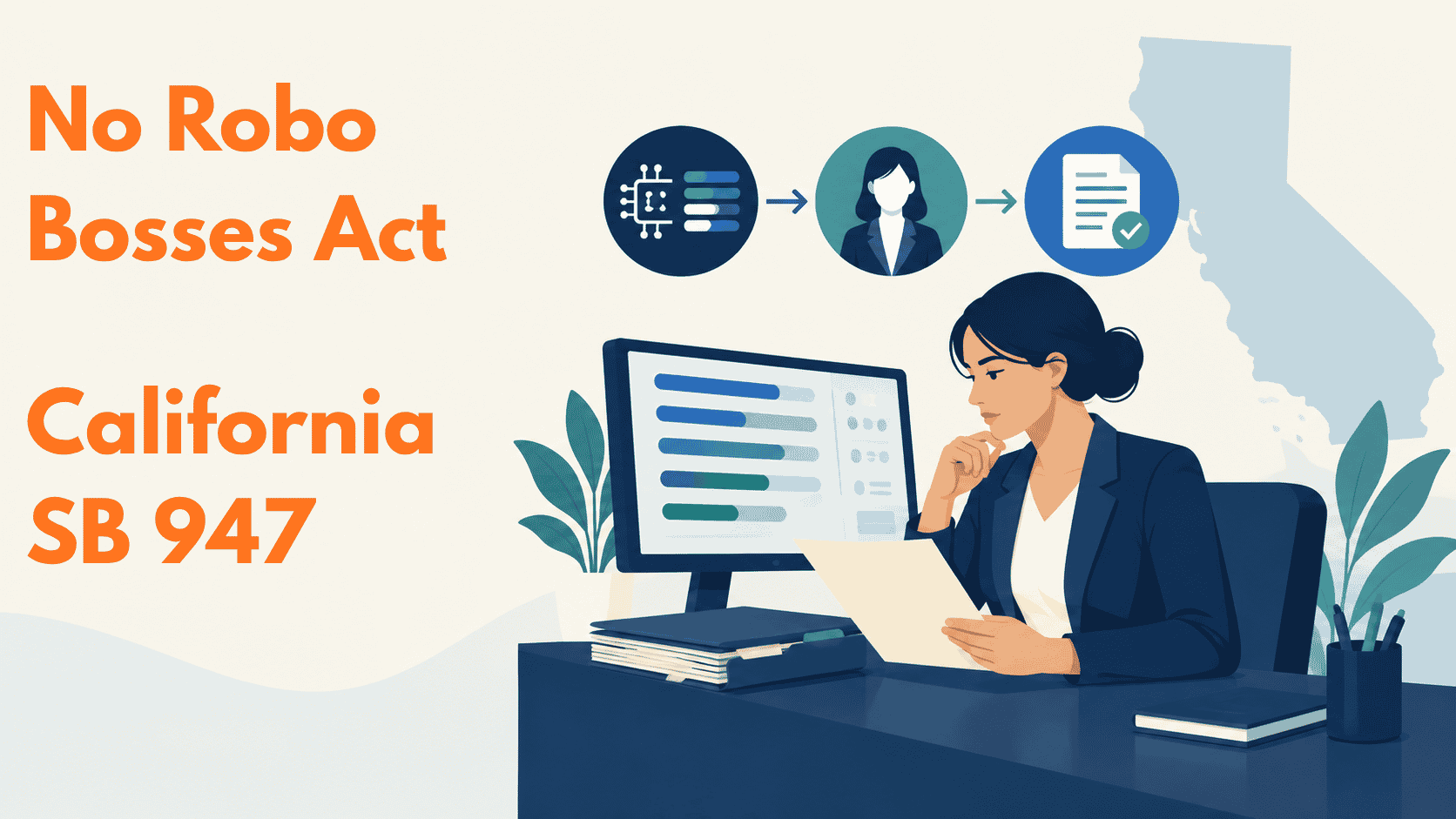
SB 947 is enacted and its automated decision system provisions become operative July 1, 2027. The law expressly includes farm labor contractors. An automated decision system (ADS) can include a score or recommendation from data analytics, statistical modeling, machine learning, or AI that assists or replaces human discretion and materially affects people. Ordinary calculators and databases are excluded; evaluate how each feature is actually used.
- Inventory tools that score workers or flag them for action, including productivity rankings and attendance recommendations. A dashboard showing raw counts is different from a score used to recommend discipline. Do not use an ADS to infer protected status or to predict and take adverse action for exercising legal rights.
- Never rely solely on an ADS for discipline or termination. If you primarily rely on one, direct a human reviewer to corroborate the decision with underlying data or other relevant evidence. Do not use output that cannot be corroborated or that the reviewer finds inaccurate, incomplete, or misleading.
- When primarily relying on an ADS, provide a separate, plain-language written postuse notice when communicating the decision, in the language used for routine employee communications. Include the reliance on the ADS, human corroboration, a human contact and the employee’s data-access right, and protection against retaliation. Be ready to provide an objective description of the employee’s own data used upon request while protecting others’ information.
How HRdeck can help: Use HRdeck to organize the policy and documentation side: a vendor inventory, human-review checklist, escalation procedures, and a draft notice for legal review. Keep the underlying data and decision evidence in authorized systems.
Your 90-day action plan
- Days 1–30: Audit one payroll, confirm your bond and renewal deadlines, verify pesticide clearance and training at active sites, and assign an owner for SB 294 delivery.
- Days 31–60: Pilot field-to-payroll approvals, issue both handbook editions, review your WVPP with crews and growers, and inventory vendor tools that score workers or recommend discipline.
- Days 61–90: Run a mock records request, verify current notices and safety postings, and test your SB 947 human review and employee notice workflows ahead of July 1, 2027.
How HRdeck fits into your farm labor operation
Use HRdeck alongside farm payroll and HRIS tools to build English and Spanish handbooks, prepare harassment-prevention training, organize notices and posters, and develop written heat illness materials. Apply the same document discipline to workplace violence prevention, pesticide training evidence, and SB 947 readiness. Keep payroll calculations, site checks, qualified training, and management decisions with the people and systems responsible for them.
This article provides general information, not legal advice. Verify requirements for your crews, worksites, vendors, and contracts before implementation.
Official source links
- California FLC licensing
- FLC examination guide
- Agricultural overtime
- Piece-rate pay
- Recordkeeping
- AB 2227
- AB 2646
- DIR workplace postings and SB 294 templates
- DIR SB 294 annual notice guidance
- DPR pesticide safety: employers and trainers
- DPR pesticide safety regulations
- Cal/OSHA workplace violence prevention in agriculture
- Cal/OSHA outdoor heat standard
- Cal/OSHA wildfire smoke standard
- Cal/OSHA field sanitation standard
- SB 947 chaptered text